Analysis of Australian Suicide Prevention and Postvention Programs

24 March 2026
?Hi team, Can you please add a publication to the research and studies publication page. On the web page, please also include the below Overview paragraph. Assistant Secretary, Wellbeing Programs and Rehab Branch has approved this publication. Let me know if you have any questions. --------------- Analysis of Australian Suicide Prevention and Postvention Programs publication cover

Analysis of Australian Suicide Prevention and Postvention Programs

Overview

The Department of Veterans' Affairs (DVA) commissioned Australian Catholic University (ACU) National Centre for Veterans and Families to determine the number and accessibility of suicide prevention and postvention programs for the Australian veteran community. The project aims to enhance DVA's understanding of the number and location of Australian suicide prevention and postvention programs and the future needs of the veteran community regarding suicide prevention and postvention programs.

First Author
Research Provider
Research Publication Type
Service Period
Subcategory Topic

Veterans' Needs in Aged Care literature review

18 March 2026

Veterans' Needs in Aged Care Literature Review Research Summary

Veterans' Needs in Aged Care Literature Review Final Report

Overview

The Department of Veterans' Affairs commissioned the Australian Institute of Family Studies (AIFS) to identify and synthesise existing research on older veterans, and their families’ experiences and needs in aged care. The project was commissioned to inform any future improvements to the way aged care is delivered to veterans and to identify gaps in understanding of the needs of older veterans and their families in aged care settings.

First Author
Research Publication Type
Service Period

Defence and Veteran Family Wellbeing Strategy and First Action Plan

18 March 2026
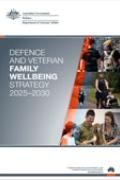
Defence and Veteran Family Wellbeing Strategy 2025-2030

Defence and Veteran Family Wellbeing Strategy and First Action Plan

Overview

The Defence and Veteran Family Wellbeing Strategy 2025-2030 has been developed to recognise the pivotal role families play in supporting current and former serving Australian Defence Force members. 

The Department of Defence and the Department of Veterans’ Affairs worked closely together to develop the Strategy and First Action Plan. This coordinated approach ensures that the impacts of service and related life events on families are managed, both during and after service, with appropriate fit-for-purpose policies, programs and support – now and in the future.

Over the next 5 years, this Strategy will guide how the Department of Defence (Defence) and the Department of Veterans’ Affairs (DVA) provide targeted support to Defence and veteran families. 

The Strategy outlines how families will be supported, reaffirms a commitment to understanding their needs, and prioritises stronger engagement and ongoing support to enhance their wellbeing.

The First Action Plan outlines the actions that Defence and DVA will initially take to achieve the Strategy’s objectives. Defence and DVA will update the Action Plan as actions progress, with the most current version available here.

First Author
Research Publication Type
Service Period

Intimate Partner Violence among current and ex-serving Australian Defence Force personnel and families

18 March 2026

Intimate Partner Violence among current and ex-serving Australian Defence Force personnel and families - Full report

Intimate Partner Violence among current and ex-serving Australian Defence Force personnel and families - Summary of findings

Overview

In Australian-first research, the Department of Veterans’ Affairs (DVA) commissioned Phoenix Australia – Centre for Posttraumatic Mental Health to examine the rates of intimate partner violence among current- and ex-serving Australian Defence Force (ADF) personnel, using data collected in 2015 from a large-scale study of current (at the time) and recently (then) transitioned ADF personnel and their families.

For the purposes of this research, the Transition and Wellbeing Research Programme data was used to:

  • examine the rates of intimate partner violence within the Australian veteran community;
  • identify vulnerable groups; and
  • provide an understanding of the implications of intimate partner violence on help-seeking and service utilisation.

Findings from the study suggest an elevated number of veteran families having experienced IPV, identifying them as a vulnerable cohort. 

Future application

The findings highlight opportunities for continued action to address intimate partner violence in the veteran community, a national priority for the Australian Government and the DVA.

The research will inform and enhance work already underway, including DVA’s Family and Domestic Violence Strategy 2020-2025, the National Plan to End Violence Against Women and Children 2022-2032, and the Defence Strategy for Preventing and Responding to Family and Domestic Violence 2023-2028.

How can we support you

If you, or someone you know, is at risk of violence, call Open Arms – Veterans & Families Counselling on 1800 011 046. In an emergency, call triple zero (000).

Research Publication Type
Service Period

Horizon Scan: Mental Health and Wellbeing Service Delivery (2022)

18 March 2026

Horizon Scan Report

Overview

The Department of Veterans' Affairs commissioned the University of Newcastle via its College of Health, Medicine and Wellbeing – Centre for Brain and Mental Health Research, to conduct a Horizon Scan of mental health and wellbeing service delivery, with a specific focus on veterans and families. The objective of the Horizon Scan was to identify trends, threats, opportunities, drivers of change and alternative approaches for the department's Mental Health and Wellbeing Services Division (MHWSD) and the broader mental health, wellbeing and veteran and family support sectors, in order to inform the work of the MHWSD Service Review and Transformation Program.

The Horizon Scan was conducted between April and November 2022, and included consultation with representatives from the veteran community (including families), veteran support organisations, academia, government, and professional experts and organisations.

Research Publication Type
Service Period

Rapid Evidence Assessment to support active ageing for veterans

18 March 2026

Technical Report

Evidence Profile

Overview

Findings from the REA identify strategies to support and sustain healthy behaviours as part of active ageing in Australian veterans. The research suggests that interventions that promote an active physical and cognitive lifestyle not only help prevent and combat mental and physical health decline, they also increase quality of life and well-being in later life for all veterans.

Research Provider
Service Period

The Tasmanian veteran needs assessment and wellbeing support service feasibility report

18 March 2026
Cover page of the Tasmanian veteran needs assessment and wellbeing support service feasibility report

the Tasmanian veteran needs assessment and wellbeing support service feasibility report

Cover page of Appendix 1: The project

Appendix 1: The project

Cover page of Appendix 2: Tasmania wellbeing support service study  Desktop review

Appendix 2: Tasmania wellbeing support service study — Desktop review

Cover page of Appendix 3: Consultation data

Appendix 3: Consultation data

Cover page of Appendix 4: Model feasibility

Appendix 4: Model feasibility

Overview

The Tasmanian Feasibility Study, commissioned by the Commonwealth and Tasmanian Governments, engaged with stakeholders, including veterans and their families, Ex-service Organisations and service providers to collect data on the current service delivery environment in Tasmania.

The study shows support for more accessible localised services for veterans and their families in Tasmania. 

Research Publication Type
Service Period

Vietnam Veterans Family Study (2014)

18 March 2026
Cover image of the Vietnam Veterans Family Study Volume 1: Introduction and Summary of the Studies of Vietnam Veteran Families

Volume 1: Introduction and Summary of the Studies of Vietnam Veteran Families

Cover image of the Vietnam Veterans Family Study Volume 2: A Study of Health and Social Issues in Vietnam Veteran Sons and Daughters

Volume 2: A Study of Health and Social Issues in Vietnam Veteran Sons and Daughters

Cover image of the Vietnam Veterans Family Study Volume 3: A Study of Mortality Patterns of Vietnam Veteran Families

Volume 3: A Study of Mortality Patterns of Vietnam Veteran Families

Cover image of the Vietnam Veterans Family Study Volume 4: Supplementary Studies of Vietnam Veteran Families' Experiences

Volume 4: Supplementary Studies of Vietnam Veteran Families' Experiences

Cover image of the Vietnam Veterans Family Study Media backgrounder

Vietnam Veterans Family Study Media backgrounder

Cover image of the Ex-Service Organisation Round Table (ESORT) Vietnam Veterans Family Study Feedback Paper

Ex-Service Organisation Round Table (ESORT) Vietnam Veterans Family Study Feedback Paper

Cover page of Spouses and Partners of Vietnam Veterans  Findings from the Vietnam Veterans Family Study

Spouses and Partners of Vietnam Veterans – Findings from the Vietnam Veterans Family Study

Cover page of Spouses and Partners of Vietnam Veterans  Summary of findings from the Vietnam Veterans Family Study

Spouses and Partners of Vietnam Veterans – Summary of findings from the Vietnam Veterans Family Study

Government response to the vietnam veterans family study 2014 - thumbnail

Government response to the Vietnam Veterans Family Study 2014

Overview

The Vietnam Veterans Family Study (VVFS) is the most significant research program ever undertaken by the Australian Government into the health of the families of Australia’s Vietnam veterans. The four volumes, released in 2014, examine the effect of Vietnam War service on the physical, mental and social health of the sons and daughters of Vietnam veterans. 

Over 27,000 people participated in the studies, including Vietnam veterans, partners and their children. Defence Force personnel of the same era who did not deploy to Vietnam, and their families, participated in the study as a control group.

A further report, titled Spouses and Partners of Vietnam Veterans – Findings from the Vietnam Veterans Family Study, was commissioned following consultation with the veteran community through the Ex-Service Organisation Round Table (ESORT). Feedback from stakeholders highlighted the importance of including spouses and partners in the VVFS analysis. 

Information about the consultation process, ESORT’s recommendations, and the Government Response can be found below.

Findings

The VVFS found that the majority of sons and daughters born to Vietnam veterans are leading healthy and productive lives. However, analysis found that the families of Australia’s Vietnam veterans are more likely to have considerable emotional, physical, and social issues when compared to families of those who served in that era but did not deploy to Vietnam.

When examining mortality amongst the children of Vietnam veterans, the research found that the children of Vietnam veterans and Vietnam-era personnel had lower mortality rates when compared to the general Australian population and that there were no significant differences in deaths from cancer. Sons of Vietnam veterans deployed had a higher mortality rate compared with Vietnam-era personnel from late teenage years to adulthood, largely due to external causes which include car accidents, misadventure and suicide.

To see the full reports released in 2014 please follow these links:

The report Spouses and Partners of Vietnam Veterans – Findings from the Vietnam Veterans Family Study confirms the long-term impact of Vietnam War service on family members. The two main areas that partners were faring less well in were mental health and couple relationships, though significant results were also found for perceptions of general physical health, perceptions of family relationships and socio-economic disadvantage.

The study confirms that veteran partners should continue to be considered in the design of early intervention supports to help reduce the long term impact of military service on families.

Support services

The research shows that operational service affects more than just the person who serves. It can also impact on family members which is why DVA has services to help families adjust and cope. Studies such as these help inform support programs and services.

For veterans and their families, support is available through Open Arms — Veterans & Families Counselling. Open Arms provides 24 hour, free and confidential counselling and support to veterans and their families. For more information, call 1800 011 046 or visit the Open Arms website.

Families can find out about support available from DVA on the website.

More information about mental health support is also available here.

Further information

For further information, see also:

First Author
Research Publication Type
Service Period
Subcategory Topic

Risk factors for ex-serving defence personnel to enter corrective services systems

18 March 2026

Rapid Evidence Assessment

Overview

This Rapid Evidence Assessment investigates the research literature analysing the risk factors for ex-serving personnel entering corrective services systems in Australia and/or other relevant jurisdictions. The report examines and synthesises recent research evidence regarding risk factors for entry into corrective services systems by ex-serving personnel across the United States, the United Kingdom and Australia.

First Author
Research Provider
Service Period

The health and wellbeing of female Vietnam and contemporary veterans 2012

13 March 2026
Cover image of final report showing the ANU Enterprise logo.

Appendices to the report

Cover image of final report showing the ANU Enterprise logo.

The Health and Wellbeing of Female Vietnam and Contemporary Veterans Report

Cover image of ADF Service Women Steering Committee report showing Australian Government logo

The ADF Service Women Steering Committee Report

Cover image of ADF Service Women Steering Committee report showing Australian Government logo

The joint Defence/DVA response

Overview

The Department of Veterans’ Affairs (DVA) commissioned Dr Samantha Crompvoets to lead a study in 2009 into the health and wellbeing of female Vietnam and contemporary veterans. The study was completed in 2012. The report’s findings were based on in-depth interviews with 60 female veterans and 30 workers in the female veteran health and wellbeing field, as well as reviews of previous research.

The ADF Service Women Steering Committee report and joint Defence/DVA response 

The Departments of Veterans’ Affairs and Defence jointly established the ADF Service Women Steering Committee (the Committee) to provide recommendations for improving Defence and DVA services for current and former ADF members. The Committee’s membership included current and former soldiers, sailors and air women (regular/permanent and reserve).

The Committee considered Dr Crompvoets’ report and discussed practical ways to improve current and former ADF service women’s access to services.

The Committee concluded that there are no major gaps evident in Defence or DVA services for current and former ADF service women, but identified that there was a lack of awareness by women of available support and services.

The Committee also found that significant changes have occurred with the services provided by Defence and DVA during and since Dr Crompvoets’ study that have enhanced care and support for contemporary veterans, including female veterans, and their families.

The Committee made 24 recommendations. DVA and Defence have accepted the majority of the Committee’s recommendations and will continue to work together to improve responsiveness to the needs of women who serve or have served our nation.

The ADF Service Women Steering Committee

With approximately 14 per cent of the Australian Defence Force (ADF) being female, female veterans are making up an increasing proportion of DVA clients. In 2012, an average of 345 females served on overseas operations at any given time, with their roles including logistics, health, communications, transport, signals, engineering and intelligence. The start of 2013 saw the ADF open all employment categories to servicewomen and a new Army recruitment campaign to increase the number of women serving over the next 12 months.

More than 11 000 veterans with one or more accepted conditions under any Act administered by DVA are female. In the last few years the Department has significantly improved services for contemporary veterans, including female veterans. DVA and Defence have also recognised that female veterans have unique requirements and so have established an ADF Service Women Steering Committee to inform both departments of the specific needs of women.

The committee is co-chaired by Gayle Anderson, Assistant Secretary Service Development and Defence Relations Branch (DVA) and MAJGEN Gerard Fogarty AO, Head of People Capability, Defence. Membership includes female current and former serving members (both regular and reserve) who have deployed on operations to Somalia, Timor Leste, Iraq and Afghanistan.

The committee is considering a broad range of information, including research by Dr Samantha Crompvoets of the Australian National University which was funded through DVA’s Applied Research Program. The study, completed in 2012, was commissioned to look at the needs of the growing number of female veterans. The report from this study into the health and wellbeing of female Vietnam and contemporary veterans is available on the DVA website.

The ADF Service Women Steering Committee has met three times between May 2013 and 30 June 2013 and will continue to meet regularly until August 2013, after which the Committee will report to the Repatriation and Military Rehabilitation and Compensation Commissions with recommendations to further guide service design.
First Author
Research Publication Type
Service Period