Veterans' Needs in Aged Care literature review

18 March 2026

Veterans' Needs in Aged Care Literature Review Research Summary

Veterans' Needs in Aged Care Literature Review Final Report

Overview

The Department of Veterans' Affairs commissioned the Australian Institute of Family Studies (AIFS) to identify and synthesise existing research on older veterans, and their families’ experiences and needs in aged care. The project was commissioned to inform any future improvements to the way aged care is delivered to veterans and to identify gaps in understanding of the needs of older veterans and their families in aged care settings.

First Author
Research Publication Type
Service Period

Defence and Veteran Family Wellbeing Strategy and First Action Plan

18 March 2026
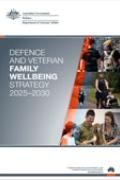
Defence and Veteran Family Wellbeing Strategy 2025-2030

Defence and Veteran Family Wellbeing Strategy and First Action Plan

Overview

The Defence and Veteran Family Wellbeing Strategy 2025-2030 has been developed to recognise the pivotal role families play in supporting current and former serving Australian Defence Force members. 

The Department of Defence and the Department of Veterans’ Affairs worked closely together to develop the Strategy and First Action Plan. This coordinated approach ensures that the impacts of service and related life events on families are managed, both during and after service, with appropriate fit-for-purpose policies, programs and support – now and in the future.

Over the next 5 years, this Strategy will guide how the Department of Defence (Defence) and the Department of Veterans’ Affairs (DVA) provide targeted support to Defence and veteran families. 

The Strategy outlines how families will be supported, reaffirms a commitment to understanding their needs, and prioritises stronger engagement and ongoing support to enhance their wellbeing.

The First Action Plan outlines the actions that Defence and DVA will initially take to achieve the Strategy’s objectives. Defence and DVA will update the Action Plan as actions progress, with the most current version available here.

First Author
Research Publication Type
Service Period

Australian Gulf War Veterans' Follow Up Health Study

13 March 2026

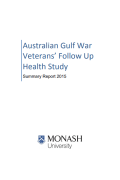
Australian Gulf War Veterans’ Follow Up Health Study — Summary Report 2015

Australian Gulf War Veterans’ Follow Up Health Study — Technical Report 2015

Overview

The Australian Gulf War Veterans’ Follow Up Health Study 2015 (Follow Up Study) is a follow up to the original Australian Gulf War Veterans’ Health Study 2003 (the 2003 study), also commissioned by DVA, to assess Gulf War veterans’ health and wellbeing 20 years after deployment.

The Follow Up Study is a longitudinal cohort study conducted from 2010 to 2015.  It compares the physical, psychological and social health and military related exposures of Australian Defence Force veterans of the First Gulf War against a military comparison group and the 2003 study.  A mortality and cancer study component of the Follow Up Study involved the entire Gulf War and military comparison groups, comprising a total of 4,793 people.

At follow up Gulf War veterans were found to be resilient. They were likely to have accessed disability and health services, which may suggest that the Gulf War cohort is seeking help when they need it.  At follow up there was a reduction in smoking, with one half of those who reported being a smoker in the 2003 study no longer smoking.

The Follow Up Study found Gulf War veteran participants were more likely than the military comparison group to suffer from a number of conditions, including posttraumatic stress disorder, alcohol disorder, chronic fatigue, irritable bowel syndrome and chronic multisymptom illness.

There were no statistically significant differences in cancer and mortality rates between Gulf War veterans and the military comparison group.

As part of the Australian Gulf War Veterans' Health Study (published in 2003), serum samples were collected from consenting participants, for long-term storage and future potential research. In 2005, a Serum Management Committee (the Committee) was established to provide oversight of the stored samples.
First Author
Research Provider
Research Publication Type
Service Period

Horizon Scan: Mental Health and Wellbeing Service Delivery (2022)

18 March 2026

Horizon Scan Report

Overview

The Department of Veterans' Affairs commissioned the University of Newcastle via its College of Health, Medicine and Wellbeing – Centre for Brain and Mental Health Research, to conduct a Horizon Scan of mental health and wellbeing service delivery, with a specific focus on veterans and families. The objective of the Horizon Scan was to identify trends, threats, opportunities, drivers of change and alternative approaches for the department's Mental Health and Wellbeing Services Division (MHWSD) and the broader mental health, wellbeing and veteran and family support sectors, in order to inform the work of the MHWSD Service Review and Transformation Program.

The Horizon Scan was conducted between April and November 2022, and included consultation with representatives from the veteran community (including families), veteran support organisations, academia, government, and professional experts and organisations.

Research Publication Type
Service Period

Protective Factors of DVA's Community Nursing program (2023)

18 March 2026

Research Summary: Investigating Protective Factors of the DVA Community Nursing program

Final Report: Investigating Protective Factors of the DVA Community Nursing program

Overview

The Department of Veterans' Affairs commissioned the University of Sydney to identify the client and service factors associated with the Community Nursing program achieving its primary aim of enabling veterans to stay at home as long as possible, avoiding early admission to hospital or residential care. The research purpose was to use the findings to strengthen the program by informing potential program improvements.

Read more about community nursing services and providers.

First Author
Research Provider
Research Publication Type
Service Period
Subcategory Topic

Active Choices: A ‘stepped-down’ program to promote self-managed physical activity in DVA clients Summary Report (2021)

18 March 2026

Technical Report

Overview

Self-managing physical activity can be challenging and programs that help DVA clients to manage their own physical activity regimes are needed. This project developed and trialled a new physical activity support program for DVA clients called Active Choices

First Author
Research Publication Type
Service Period

Rapid Evidence Assessment to support active ageing for veterans

18 March 2026

Technical Report

Evidence Profile

Overview

Findings from the REA identify strategies to support and sustain healthy behaviours as part of active ageing in Australian veterans. The research suggests that interventions that promote an active physical and cognitive lifestyle not only help prevent and combat mental and physical health decline, they also increase quality of life and well-being in later life for all veterans.

Research Provider
Service Period

Timor-Leste Family Study (2012)

18 March 2026

Technical Report

Overview

This study investigated the effects on the health and wellbeing of the families of Australian Defence Force members who were deployed to Timor-Leste, and a control group of those who were eligible to deploy to Timor-Leste but did not.

First Author
Research Publication Type
Service Period

The importance of sport for veteran physical and mental wellbeing

18 March 2026
Overview

The aim of this Rapid Evidence Assessment (REA) was to examine the evidence to investigate the physical and mental wellbeing benefits veterans achieve through participating in sporting activities and whether these benefits are linked to the type of sporting activity being undertaken.

The aim of this Rapid Evidence Assessment (REA) was to examine the evidence to investigate the physical and mental wellbeing benefits veterans achieve through participating in sporting activities and whether these benefits are linked to the type of sporting activity being undertaken.

Research Publication Type
Service Period

‘Stepped-down’ Intervention Programs to Promote Self-managed Physical Activity in Service Veterans and their Dependants

18 March 2026
Overview

The aim of this Rapid Evidence Assessment (REA) was to: 1) examine the scientific literature for evidence on the effectiveness of interventions to promote self-managed physical activity in service veterans and/or their dependants; 2) assess studies that compared the effectiveness of ‘stepped-down’ models of PA self-management to ‘usual care’ controls and; 3) identify key behaviour change techniques that have been used in these studies to successfully promote physical activity change.

First Author
Research Publication Type
Service Period
Subcategory Topic