Intimate Partner Violence among current and ex-serving Australian Defence Force personnel and families

18 March 2026

Intimate Partner Violence among current and ex-serving Australian Defence Force personnel and families - Full report

Intimate Partner Violence among current and ex-serving Australian Defence Force personnel and families - Summary of findings

Overview

In Australian-first research, the Department of Veterans’ Affairs (DVA) commissioned Phoenix Australia – Centre for Posttraumatic Mental Health to examine the rates of intimate partner violence among current- and ex-serving Australian Defence Force (ADF) personnel, using data collected in 2015 from a large-scale study of current (at the time) and recently (then) transitioned ADF personnel and their families.

For the purposes of this research, the Transition and Wellbeing Research Programme data was used to:

  • examine the rates of intimate partner violence within the Australian veteran community;
  • identify vulnerable groups; and
  • provide an understanding of the implications of intimate partner violence on help-seeking and service utilisation.

Findings from the study suggest an elevated number of veteran families having experienced IPV, identifying them as a vulnerable cohort. 

Future application

The findings highlight opportunities for continued action to address intimate partner violence in the veteran community, a national priority for the Australian Government and the DVA.

The research will inform and enhance work already underway, including DVA’s Family and Domestic Violence Strategy 2020-2025, the National Plan to End Violence Against Women and Children 2022-2032, and the Defence Strategy for Preventing and Responding to Family and Domestic Violence 2023-2028.

How can we support you

If you, or someone you know, is at risk of violence, call Open Arms – Veterans & Families Counselling on 1800 011 046. In an emergency, call triple zero (000).
Research Publication Type
Service Period

Is online video counselling at least equally acceptable and equally as effective as in-person counselling?

18 March 2026
Overview

The aim of this Rapid Evidence Assessment (REA) was to investigate the efficacy of one-to-one online video counselling for the treatment of adults with mental health concerns and compare this treatment with traditional in-person counselling in terms of clinical outcomes, therapeutic alliance, client satisfaction and attrition.

First Author
Research Publication Type
Service Period

Literature review of effects of fuel and solvent exposure on human female reproductive outcomes

16 March 2026
Overview

The aim of this Rapid Evidence Assessment (REA) was to conduct a review of the scientific evidence regarding whether occupational exposures to jet fuels and specified solvents of most relevance to the military were associated with risks to the reproductive health of women.

First Author
Research Provider
Service Period

Psychological and vocational outcomes of delivering support services to the families of veterans at times of high family stress

18 March 2026
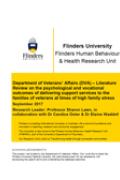
Literature review cover page

Psychological and vocational outcomes of delivering support services to the families of veterans at times of high family stress

Overview

This report was funded by the Department of Veterans’ Affairs to assess available literature on the psychological and vocational outcomes of delivering support services to the families of veterans at times of high family stress. The review considered interventions being provided to veterans in Australia, and other English speaking countries who may have similar veteran experiences.  

The literature review was undertaken in the context of the growing body of research and policy evidence suggesting that veterans can be challenged by transition from the Australian Defence Force (ADF) into civilian life, with a consequential direct negative impact on the wellbeing of the veteran and family members. The aim of this literature review was to examine available peer reviewed research regarding the support available to families of veterans in order to inform the establishment of a policy framework.

  • The review yielded 34 results, primarily considering the experiences of veterans and their families in the United States. The absence of peer-reviewed literature from New Zealand, Canada and the United Kingdom highlights that this topic is one that is still in its infancy.
  • Overall, studies indicated that family involvement in care was most definitely a contributing factor to veterans achieving positive psychological and interpersonal outcomes. The review noted that younger veterans, in particular, liked the message of family involvement, the use of digital support tools and therapy that accommodated childcare needs.
  • While the literature highlights some potential programs which could assist Australian veterans and their families, including online education tools for adults and children, the need for further research in this area is apparent, specifically in the Australian context.
First Author
Research Provider
Research Publication Type
Service Period