Analysis of Australian Suicide Prevention and Postvention Programs

24 March 2026
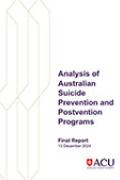
?Hi team, Can you please add a publication to the research and studies publication page. On the web page, please also include the below Overview paragraph. Assistant Secretary, Wellbeing Programs and Rehab Branch has approved this publication. Let me know if you have any questions. --------------- Analysis of Australian Suicide Prevention and Postvention Programs publication cover

Analysis of Australian Suicide Prevention and Postvention Programs

Overview

The Department of Veterans' Affairs (DVA) commissioned Australian Catholic University (ACU) National Centre for Veterans and Families to determine the number and accessibility of suicide prevention and postvention programs for the Australian veteran community. The project aims to enhance DVA's understanding of the number and location of Australian suicide prevention and postvention programs and the future needs of the veteran community regarding suicide prevention and postvention programs.
First Author
Research Provider
Research Publication Type
Service Period
Subcategory Topic

Defence and Veteran Family Wellbeing Strategy and First Action Plan

18 March 2026
Defence and Veteran Family Wellbeing Strategy 2025-2030

Defence and Veteran Family Wellbeing Strategy and First Action Plan

Overview

The Defence and Veteran Family Wellbeing Strategy 2025-2030 has been developed to recognise the pivotal role families play in supporting current and former serving Australian Defence Force members. 

The Department of Defence and the Department of Veterans’ Affairs worked closely together to develop the Strategy and First Action Plan. This coordinated approach ensures that the impacts of service and related life events on families are managed, both during and after service, with appropriate fit-for-purpose policies, programs and support – now and in the future.

Over the next 5 years, this Strategy will guide how the Department of Defence (Defence) and the Department of Veterans’ Affairs (DVA) provide targeted support to Defence and veteran families. 

The Strategy outlines how families will be supported, reaffirms a commitment to understanding their needs, and prioritises stronger engagement and ongoing support to enhance their wellbeing.

The First Action Plan outlines the actions that Defence and DVA will initially take to achieve the Strategy’s objectives. Defence and DVA will update the Action Plan as actions progress, with the most current version available here.

First Author
Research Publication Type
Service Period

Australian Gulf War Veterans' Health Study

18 March 2026

Australian Gulf War Veterans' Health Study - Volume one

Australian Gulf War Veterans' Health Study - Volume two

Australian Gulf War Veterans' Health Study - Volume three

Australian Gulf War Veterans' Health Study - Executive Summary

Overview

The Australian Gulf War Veterans’ Health Study was the first comprehensive health study of a group of Australian War veterans involved in a single theatre of war.

It was conducted by a collaborative medical research team from the Department of Epidemiology & Preventive Medicine at Monash University, Health Services Australia Ltd, the University of Western Australia, and The Australian Centre for Posttraumatic Mental Health at the University of Melbourne.

As part of the Australian Gulf War Veterans' Health Study (published in 2003), serum samples were collected from consenting participants, for long-term storage and future potential research. In 2005, a Serum Management Committee (the Committee) was established to provide oversight of the stored samples.

First Author
Research Provider
Research Publication Type
Service Period
Subcategory Topic

Emerging Treatments for Common Mental Health Conditions Affecting Veterans: D-Cycloserine Interventions

16 March 2026

Emerging Treatments for Common Mental Health Conditions Affecting Veterans: D-Cycloserine Interventions

Overview

DVA commissioned Gallipoli Medical Research Foundation (GMRF) to undertake a rolling Rapid Evidence Assessment (REA) of emerging and adjunct treatments for post-traumatic stress disorder (PTSD) and common mental health conditions affecting veterans. The emerging treatments were psychedelic interventions (i.e., ketamine; methylenedioxymethamphetamine, MDMA; lysergic acid diethylamide, LSD; psilocybin; and dimethyltryptamine, DMT, including ayahuasca), medicinal cannabis, d-cycloserine (DCS), stellate ganglion block (SGB), and transcranial magnetic stimulation (TMS, including theta burst stimulation, TBS). The initial REA was delivered in a tranche of seven individual reports in 2022. Four update reports were contracted at 6-monthly intervals to incorporate the most up-to-date information from newly published studies. The goal of the REA was to provide an evidence base to develop a flexible, yet robust, decision-making process that allows DVA to assess emerging treatments for veterans who have not responded to evidence-based treatments.

First Author
Research Provider
Research Publication Type
Service Period
Subcategory Topic

DVA Health Programs Evaluations Approaches Review Report (2023)

18 March 2026

DVA Health Programs Evaluations Approaches Review Report (2023)

Overview

The Department of Veterans' Affairs commissioned Ernst & Young to conduct a review of better practice approaches in the evaluation of health and wellbeing programs. The aim of the review was to provide recommendations regarding the existing types of evaluation occurring within health programs across Australia (e.g. process, impact, economic/value for money, fidelity, outcome), including the appropriate use of each type of evaluation. These recommendations help inform how the department can plan for and carry out evaluations to support the wellbeing of veterans and families.

First Author
Research Provider
Research Publication Type
Service Period
Subcategory Topic

Horizon Scan: Mental Health and Wellbeing Service Delivery (2022)

18 March 2026

Horizon Scan Report

Overview

The Department of Veterans' Affairs commissioned the University of Newcastle via its College of Health, Medicine and Wellbeing – Centre for Brain and Mental Health Research, to conduct a Horizon Scan of mental health and wellbeing service delivery, with a specific focus on veterans and families. The objective of the Horizon Scan was to identify trends, threats, opportunities, drivers of change and alternative approaches for the department's Mental Health and Wellbeing Services Division (MHWSD) and the broader mental health, wellbeing and veteran and family support sectors, in order to inform the work of the MHWSD Service Review and Transformation Program.

The Horizon Scan was conducted between April and November 2022, and included consultation with representatives from the veteran community (including families), veteran support organisations, academia, government, and professional experts and organisations.

Research Publication Type
Service Period

Protective Factors of DVA's Community Nursing program (2023)

18 March 2026

Research Summary: Investigating Protective Factors of the DVA Community Nursing program

Final Report: Investigating Protective Factors of the DVA Community Nursing program

Overview

The Department of Veterans' Affairs commissioned the University of Sydney to identify the client and service factors associated with the Community Nursing program achieving its primary aim of enabling veterans to stay at home as long as possible, avoiding early admission to hospital or residential care. The research purpose was to use the findings to strengthen the program by informing potential program improvements.

Read more about community nursing services and providers.

First Author
Research Provider
Research Publication Type
Service Period
Subcategory Topic

PTSD Assistance Dogs research trial

18 March 2026

Assistance Dogs Trial evaluation findings - Full report

Assistance Dogs Trial evaluation findings - Abridged

Overview

DVA funded a four-year research trial through La Trobe University, in partnership with the Centre for Service and Therapy Dogs Australia (CSTDA), to provide detailed guidance and evidence to support best practice in the use of psychiatric assistance dogs for veterans with PTSD. Evolution Research were engaged to conduct the independent evaluation of the Trial.

The Trial’s objective was to train, allocate and monitor assistance dogs as an adjunct to evidence-based treatment for veterans with PTSD, to determine the following outcomes: 

  • the clinical utility of using specifically-trained assistance dogs as an adjunct to evidence-based treatment for PTSD in a veteran population; 
  • the benefits of specifically-trained assistance dogs used by veterans with PTSD in decreasing related caregiver burden; and 
  • the key barriers and enablers for a possible future broader implementation of an assistance dog program of the type conducted under the Trial. 

The Trial evaluated the life experiences of 20 veterans with a diagnosis of PTSD through their journey of being paired with a specifically trained assistance dog. The veteran’s journey commenced at the time of recruitment and initial assessment, involvement in a comprehensive training program and matching of a dog to meet their unique needs. Following completion of the training program and preparedness the veteran received handover of their dog to live with them full time. 

Of the 20 veterans recruited, a total of 17 completed the Trial on 30 June 2022 and continue to live with their dog. The three veterans that did not complete the Trial voluntarily withdrew due to personal circumstances. Exit interviews to capture their experiences were conducted and noted in the evaluation report.

The Trial was successful in meeting its objectives and the evaluation findings and recommendations are being considered by DVA’s Psychiatric Assistance Dog Program for opportunities to enhance delivery of the Program.

The following comments were captured from trial participants and support persons during the evaluation and are included in the report

“I can’t express enough how much this program has been of benefit. I have little doubt that my service dog has saved my life” – Veteran John

“My wife says she “has the old me back”, my parents have commented on the change the dog has had on me, with comments such as…”we haven’t seen this bloke in 20yrs” – Veteran Brian

“I have more freedoms to do things that I like without feeling guilty or worrying about my husband. I cannot thank them enough for their dedication, patience and care shown to not only my husband but our entire family” - Support Person Jenny

“Conversations about difficult subjects have become approachable and easier. Our communication has improved in all aspects of our life” – Support Person Susan

Research Publication Type
Service Period

Dental and Allied Health Reforms

18 March 2026

DVA Alternative Funding Models for Allied Health Services for Veterans

DVA Treatment Cycle Evaluation Report

Overview

A reform package in the 2018–19 Budget provided funding to further improve our dental and allied health services through a number of initiatives.  Below are reports relating to the Treatment Cycle Evaluation and Desktop Analysis of Alternative Funding Models for Allied Health Services.

First Author
Research Provider
Research Publication Type
Service Period
Subcategory Topic

The Tasmanian veteran needs assessment and wellbeing support service feasibility report

18 March 2026
Cover page of the Tasmanian veteran needs assessment and wellbeing support service feasibility report

the Tasmanian veteran needs assessment and wellbeing support service feasibility report

Cover page of Appendix 1: The project

Appendix 1: The project

Cover page of Appendix 2: Tasmania wellbeing support service study  Desktop review

Appendix 2: Tasmania wellbeing support service study — Desktop review

Cover page of Appendix 3: Consultation data

Appendix 3: Consultation data

Cover page of Appendix 4: Model feasibility

Appendix 4: Model feasibility

Overview

The Tasmanian Feasibility Study, commissioned by the Commonwealth and Tasmanian Governments, engaged with stakeholders, including veterans and their families, Ex-service Organisations and service providers to collect data on the current service delivery environment in Tasmania.

The study shows support for more accessible localised services for veterans and their families in Tasmania. 

Research Publication Type
Service Period