Australian Gulf War Veterans' Health Study

18 March 2026

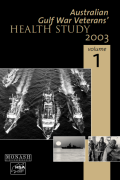
Australian Gulf War Veterans' Health Study - Volume one

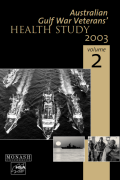
Australian Gulf War Veterans' Health Study - Volume two

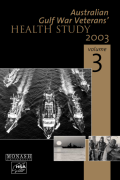
Australian Gulf War Veterans' Health Study - Volume three

Australian Gulf War Veterans' Health Study - Executive Summary

Overview

The Australian Gulf War Veterans’ Health Study was the first comprehensive health study of a group of Australian War veterans involved in a single theatre of war.

It was conducted by a collaborative medical research team from the Department of Epidemiology & Preventive Medicine at Monash University, Health Services Australia Ltd, the University of Western Australia, and The Australian Centre for Posttraumatic Mental Health at the University of Melbourne.

As part of the Australian Gulf War Veterans' Health Study (published in 2003), serum samples were collected from consenting participants, for long-term storage and future potential research. In 2005, a Serum Management Committee (the Committee) was established to provide oversight of the stored samples.
First Author
Research Provider
Research Publication Type
Service Period
Subcategory Topic

Australian Gulf War Veterans' Follow Up Health Study

13 March 2026

Australian Gulf War Veterans’ Follow Up Health Study — Summary Report 2015

Australian Gulf War Veterans’ Follow Up Health Study — Technical Report 2015

Overview

The Australian Gulf War Veterans’ Follow Up Health Study 2015 (Follow Up Study) is a follow up to the original Australian Gulf War Veterans’ Health Study 2003 (the 2003 study), also commissioned by DVA, to assess Gulf War veterans’ health and wellbeing 20 years after deployment.

The Follow Up Study is a longitudinal cohort study conducted from 2010 to 2015.  It compares the physical, psychological and social health and military related exposures of Australian Defence Force veterans of the First Gulf War against a military comparison group and the 2003 study.  A mortality and cancer study component of the Follow Up Study involved the entire Gulf War and military comparison groups, comprising a total of 4,793 people.

At follow up Gulf War veterans were found to be resilient. They were likely to have accessed disability and health services, which may suggest that the Gulf War cohort is seeking help when they need it.  At follow up there was a reduction in smoking, with one half of those who reported being a smoker in the 2003 study no longer smoking.

The Follow Up Study found Gulf War veteran participants were more likely than the military comparison group to suffer from a number of conditions, including posttraumatic stress disorder, alcohol disorder, chronic fatigue, irritable bowel syndrome and chronic multisymptom illness.

There were no statistically significant differences in cancer and mortality rates between Gulf War veterans and the military comparison group.

As part of the Australian Gulf War Veterans' Health Study (published in 2003), serum samples were collected from consenting participants, for long-term storage and future potential research. In 2005, a Serum Management Committee (the Committee) was established to provide oversight of the stored samples.
First Author
Research Provider
Research Publication Type
Service Period

Mortality and Cancer Incidence in Australian Vietnam Veterans Studies (2005)

13 March 2026
Cancer Incidence in Australian Vietnam Veterans Study 2005 cover page

Cancer Incidence in Australian Vietnam Veterans Study 2005

Cancer Incidence in Australian Vietnam Veterans Study 2005 cover page

The Third Australian Vietnam Veterans Mortality Study 2005

Cancer Incidence in Australian Vietnam Veterans Study 2005 cover page

Australian National Service Vietnam Veterans: Mortality and Cancer Incidence 2005

Cancer Incidence in Australian Vietnam Veterans Study 2005 cover page

Dapsone Exposure and Australian Vietnam Service: Mortality and Cancer Incidence

Cancer Incidence in Australian Vietnam Veterans Study 2005 cover page

FAQs for the Vietnam Veterans mortality and cancer incidence studies

Overview

The series of studies, commissioned by the Repatriation Commission, was undertaken in response to a recommendation of the 1997 Mortality of Vietnam Veterans: The Veteran Cohort Study, which was to monitor the mortality of Vietnam veterans and repeat the study after 2000.

The first three reports in a series of studies of mortality and cancer incidence in Australian Vietnam veterans were released on September 5th 2006. 

The reports were produced by the Department of Veterans’ Affairs with the assistance of the Australian Institute of Health and Welfare.

A fourth report in the series was released on 26 September 2007.

Each of the four completed reports can stand alone as a complete study. However, the first three volumes should be taken together for a more thorough understanding of the mortality and cancer incidence of this cohort of Australian Vietnam veterans and an Overarching Executive Summary has been produced to assist in understanding . The fourth volume investigates a specific aspect of Vietnam service, that is the exposure to an anti-malarial drug, Dapsone.

The reports and their overarching summary are available at Overarching Executive Summary.


First Author
Research Publication Type
Service Period

Cancer incidence study 2003: Australian veterans of the Korean War

18 March 2026
Overview

The Cancer Incidence Study 2003: Australian Veterans of the Korean War was initiated by the Australian Government in May 2001.

The Cancer Incidence Study compared the rates of cancers among the Korean War veteran population with the rates of comparable cancers among the general Australian male population of the same age.

The findings of the Study, conducted by the Australian Institute of Health & Welfare.

First Author
Research Publication Type
Service Period

Is stepped care an effective model for the delivery of treatment for depression and anxiety?

18 March 2026
Overview

The aim of this review was to examine the efficacy of stepped care for the treatment of adults with depression or anxiety disorders. In consultation with the Department of Veteran’s Affairs (DVA) a number of focal conditions were identified and the evidence to support the use of stepped care in the treatment of these was reviewed. This was an iterative process between ACPMH and DVA to capture the conditions of most relevance to DVA. The conditions initially identified were depressive disorders and anxiety disorders (i.e. GAD and posttraumatic stress disorder (PTSD)); however, an initial search of the literature suggested that other anxiety disorders such as OCD might also be considered, as well as anxiety disorders and symptoms thereof taken together.

First Author
Research Publication Type
Service Period

What are effective interventions for veterans with sleep disturbances?

18 March 2026
Overview

The aim of the current review was to examine the scientific literature for evidence of effective interventions for veterans with sleep disturbances. It is important to note that guidelines and several systematic reviews exist for the treatment of insomnia in adults however; there were no specific guidelines or systematic reviews pertaining to the treatment of sleep disturbances and/or insomnia in veterans specifically. Findings from civilian adult populations may not necessarily apply to veterans, who differ from community samples in several ways, including higher rates of psychiatric disorders and military-related causes of sleep disturbances. As such, veterans with sleep disturbances may differ in response to treatment compared to a community population.

First Author
Research Publication Type
Service Period
Subcategory Topic

What are the effective interventions for veterans with problematic anger and aggression?

18 March 2026
Overview

Despite increasing numbers of veterans returning from deployment with problematic anger and aggression, the treatment of anger within this population has not been thoroughly investigated. In contrast to areas of research such as posttraumatic stress disorder (PTSD), there has been comparatively little attention directed toward other less clinically prominent behavioural outcomes of combat exposure that still have the potential to adversely impact the health and well-being of returning service members. The aim of this Rapid Evidence Assessment was to examine the scientific literature for evidence of effective interventions veterans with problematic anger and aggression.

First Author
Research Publication Type
Service Period
Subcategory Topic

What are effective psychological or multi-modal interventions for adults experiencing chronic pain?

18 March 2026
Overview

In the past decade there has been growing recognition of the psychosocial factors that increase vulnerability to chronic pain, and a shift towards focusing on psychological interventions that may address some of these vulnerabilities. The aim of the current review was to examine the efficacy of psychological interventions and multi-modal interventions that include a psychological component, for the treatment of chronic pain. This REA focused on those categories of psychological and multi-modal therapies that are most commonly used to treat chronic pain in adults, and which were identified as being of most relevance to DVA. Specifically, the REA examined literature relating to the efficacy of cognitive behavioural therapy (CBT), multidisciplinary pain management programs (MPMPs), mindfulness-based interventions and behavioural therapy.

First Author
Research Publication Type
Service Period
Subcategory Topic

Literature review of effects of fuel and solvent exposure on human female reproductive outcomes

16 March 2026
Overview

The aim of this Rapid Evidence Assessment (REA) was to conduct a review of the scientific evidence regarding whether occupational exposures to jet fuels and specified solvents of most relevance to the military were associated with risks to the reproductive health of women.

First Author
Research Provider
Service Period

The role of meditational practices and mindfulness in improving mental health

18 March 2026
Overview

The aim of this rapid evidence assessment (REA) was to assess the evidence related to meditation and mindfulness practices (meditation, transcendental meditation, mantra, yoga, and mindfulness) for Posttraumatic Stress Disorder (PTSD), depression, anxiety, and alcohol use disorder (AUD) in adults.

First Author
Service Period