Horizon Scan: Mental Health and Wellbeing Service Delivery (2022)

18 March 2026

Horizon Scan Report

Overview

The Department of Veterans' Affairs commissioned the University of Newcastle via its College of Health, Medicine and Wellbeing – Centre for Brain and Mental Health Research, to conduct a Horizon Scan of mental health and wellbeing service delivery, with a specific focus on veterans and families. The objective of the Horizon Scan was to identify trends, threats, opportunities, drivers of change and alternative approaches for the department's Mental Health and Wellbeing Services Division (MHWSD) and the broader mental health, wellbeing and veteran and family support sectors, in order to inform the work of the MHWSD Service Review and Transformation Program.

The Horizon Scan was conducted between April and November 2022, and included consultation with representatives from the veteran community (including families), veteran support organisations, academia, government, and professional experts and organisations.

Research Publication Type
Service Period

Measuring Occupational Exposures to Osteoarthritis in the Lower Limb in ADF Job Categories (2019)

18 March 2026
Overview

The Department of Veterans’ Affairs (DVA) commissioned Bond University, Tactical Research Unit to quantify exposures that occur during the initial training of full-time Australian Defence Force (ADF) personnel and compare those findings with the exposure threshold levels set out in the Statements of Principles for osteoarthritis in the lower limb established by the Repatriation Medical Authority.

The study’s findings have supported the work undertaken by DVA to improve access to services, streamline the compensation claims process, and fast track access to treatment by lessening the need for some veterans to explain how their service has caused OLL when submitting claims to DVA.

First Author
Research Provider
Research Publication Type
Service Period
Subcategory Topic

Monash University Firefighters’ Health Study (2015)

18 March 2026
Overview

Monash University, "Defence Firefighters' Health Study" April 2015 cover

The Department of Defence, with the support of the Australasian Fire and Emergency Services Council, commissioned Monash University to undertake a statistical study into the health of current and former Australian Defence Force firefighters who served from 1980 to 2013.

The Defence Firefighters' Health Study report is part of the Australian Firefighters' Health Study (available on the Monash University website, under heading "Study Results").

All queries about this research should be directed to the Department of Defence.

First Author
Research Provider
Research Publication Type
Service Period

Providing Pathways Guidance to Young Veterans for a Successful Transition to Civilian Workforce (2016)

16 March 2026

Providing Pathways Guidance Report

Overview

The report matches DVA administrative data with community data from the Student Outcomes Survey (SOS) and the Household Income and Labour Dynamics in Australia (HILDA) survey, to better understand potential workforce outcomes for DVA clients. The report provides a predictive analysis of the impact that health conditions, medical discharge status, and service type, have on a veteran’s ability to look for and participate in work assuming community trends apply to veteran groups. The findings are not based on actual veteran employment outcomes. Nevertheless, the study is informative of potential outcomes. DVA’s rehabilitation program is aligned with the study findings.

It is important to note that the findings should be read in context of the report and as they are general in nature, they should not be considered applicable at an individual level. A one page overview of the study is also attached.

Further information:


Research Provider
Research Publication Type
Service Period

Exploring future service needs of Australian Defence Force Reservists

13 March 2026
cover image with ANU logo

Exploring future service needs of Australian Defence Force Reservists

Overview

DVA commissioned this study in 2011 to gain a better understanding of the experiences of reservists. The field-based component of the study consisted of face-to-face, semi-structured interviews with 39 ADF reservists, primarily from the Army with a smaller number from the Air Force. The text-based component centred on a review of the academic literature, as well as a review of historical documents and an inventory of support services available to reservists.

The study found that reservists vary in the way they understand their reservist identity. Some identify more with a ‘full-timer’ identity and feel a close connection with ADF membership and military skills, while some identify more as a ‘part-timer’ and place stronger emphasis on their civilian professional skills. The researcher found that the extent to which reservists identify with the ADF can affect outcomes including their health and wellbeing, cohesion with their unit and accessing of support services.

The reservists study has provided DVA with useful information about the experiences and needs of a sample of contemporary reservists. As a qualitative pilot study, the report is exploratory in nature. It does not quantify the extent to which the views expressed by the participants would be shared among reservists and reservist veterans more generally. Nevertheless, the report provides a useful understanding of issues experienced by the reservists interviewed and identified in the academic literature.

The report has informed DVA’s understanding of how reservists identify and the potential implications of this for DVA’s communication and engagement with reservists. It has also informed a focus on reservists in planning future DVA research. On 11 June 2014, the Government announced a joint DVA/Defence Transition and Wellbeing Research Programme which includes a nested study on reservists.

Reservists can access similar DVA support and services to those available to Permanent ADF members. For details on reservists’ entitlements, please see DVA website and/or the Claims for reservists. Reservists who are in doubt about what DVA services or support they could access are encouraged to contact DVA.

First Author
Research Publication Type

Literature review of effects of fuel and solvent exposure on human female reproductive outcomes

16 March 2026
Overview

The aim of this Rapid Evidence Assessment (REA) was to conduct a review of the scientific evidence regarding whether occupational exposures to jet fuels and specified solvents of most relevance to the military were associated with risks to the reproductive health of women.

First Author
Research Provider
Service Period

Solvents Reports

18 March 2026
Overview

The aim of this Rapid Evidence Assessment (REA) was to conduct a literature review of adverse sexual and reproductive health outcomes in men from occupational exposure to specified solvents relevant to the Australian military.

First Author
Research Provider

Rwanda Deployment Health Study (2014)

13 March 2026
Overview

This study aimed to examine the health and compensation outcomes of Rwanda veterans and investigate whether there were differences in outcomes between the different groups deployed.

The study undertook a data match and analysis process using personnel, compensation, health and mortality data.

Among other things, the study found that the health of the Rwanda cohort is characterised by a high rate of post-traumatic stress disorder (PTSD) that is expressed in two compensation peaks five and 11 years after the deployment.

There was no evidence of difference in discharge rates between the contingents, between personnel groups or between personnel from formed units and those who joined deployments individually.

First Author
Research Publication Type

Review of SAS Veterans' Health Concerns

18 March 2026
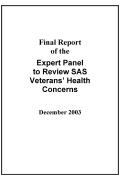
Final report of the Expert Panel to Review SAS Veterans' Health Concerns December 2003

Review of SAS Veterans' Health Concerns

Overview

The Report of the Expert Panel to Review SAS Veterans’ Health Concerns and the Government's response were released in March 2004.

The health study was initiated in December 2002 to identify and document exposures of concern arising through Special Air Services (SAS) operational skills enhancement and training, and to examine their possible adverse effects. The Review also considered the need for further research and whether any particular matters should be drawn to the attention of the Repatriation Medical Authority (RMA).

An independent Expert Panel conducted the study. The Panel was chaired by Professor Ken Donald, who was also Chairman of the Repatriation Medical Authority, and included experts in the fields of toxicology and genetics.

First Author
Research Publication Type
Subcategory Topic

Review of Commonwealth agencies’ relationship with the late Signaller Geffrey Gregg

18 March 2026
Cover of Review of Commonwealth agencies relationship with the late Signaller Geffrey Gregg

Review of Commonwealth agencies' relationship with the late Signaller Geffrey Greg

Overview

The Government’s response (PDF) to a review of the circumstances surrounding the death of Signaller Geffrey Gregg was published on 30 July 2008. The response outlined 15 outcomes to address systemic problems with transition out of the services.

The review of SIG Gregg’s circumstances involved three parts.

Part 1 was an independent inquiry by the Inspector General Australian Defence Force, Geoff Earley AM, which examined SIG Gregg’s Defence Service, including deployment to Afghanistan, and the ADF’s role in transition management at SIG Gregg’s discharge.

Part 2 was undertaken by Mr Chris Doogan AM (former Registrar of the High Court) and examined DVA’s actions in SIG Gregg’s transition management from the ADF, DVA’s handling of his compensation claims and the actions of the Commissioner for Superannuation in administration of SIG Gregg’s claim for military superannuation benefits.

Part 3 of the review was undertaken by Mr Ron McLeod AM (former deputy Ombudsman) to examine the whole-of-government approach to handling the Gregg case.

The Minister for Veterans’ Affairs, Alan Griffin, and the Minister for Defence Science and Personnel, Warren Snowdon, issued a media release about the Government’s response.
Research Publication Type
Service Period