Today, we pause to remember all Australians who served in the Korean War.
After the Second World War, the Korean Peninsula was divided into two separate zones along the 38th parallel. The south became the Republic of Korea, and the north became the Democratic People’s Republic of Korea. There was growing tension between the two sides, and on 25 June 1950, North Korean forces invaded South Korea. In response, the United Nations called on countries to help defend South Korea and push the invasion back. Australia was one of 21 nations to provide support.
Korean Veterans’ Day marks the signing of the armistice in 1953, which ended the fighting in Korea.
Over three years, more than 18,000 personnel from the Royal Australian Navy, Australian Army and the Royal Australian Air Force served in the Korean War.
Australia’s commitment to the Korean War was costly. More than 1,200 personnel were wounded, 340 lost their lives, 29 Australians were taken prisoner, and more than 40 personnel are missing in action, presumed dead.
Private Eric Donnelly was one of the Australian Prisoners of War (POWs). Private Donnelly was captured in January 1953 while trying to rescue a wounded soldier during fighting near Hill 355 (Kowang San). Shot in the leg and unable to move in the snow, he was taken prisoner by a Chinese soldier. Private Donnelly was dropped into a trench and lost consciousness, beginning a difficult period in captivity.
Over the following days, Private Donnelly was repeatedly interrogated and denied medical treatment unless he agreed to cooperate. Despite this, he refused to give in. He was eventually moved to a Korean farmhouse where he received some basic medical treatment. Suffering from poor hygiene and limited food, Private Donnelly lost a considerable amount of weight.
POWs were sometimes targets of abuse and indoctrination. However, Private Donnelly shared an encounter that showed an unexpected act of care and humanity. He recalled:
‘The next day was the 28th of January, my 23rd birthday, and I was taken away to another building where I was given a spinal injection and a Chinese doctor, who spoke no English, performed an operation on my leg.
‘As I was lifted off the ‘operating table’, the stitching came undone and I thought I was in for another struggle when he again tried to close the wound. However, instead of trying to restitch me, he got an American field pack tin of Sulphanilamide powder [antibiotic] and sprinkled it all over the wound before I was carted off to another room.
‘My spirit was pretty low at this time as no one spoke English, it was my birthday and I was in pain and alone. In the early hours of the following morning, when the pain was at its worst, a Chinese soldier cradled my head and sang, in perfect English, the Paul Robeson song 'Swing low, sweet chariot, coming for to carry me home'. This was a very moving experience that I will always remember. The soldier could not speak English to carry on a conversation, but I found out later that he had attended an American missionary school when he was a child.’
After months as a prisoner, Private Donnelly was one of five Australian POWs who were part of an exchange of wounded and sick prisoners. Known as Operation Little Switch, the exchange took place on 23 April 1953.
On Korean Veterans’ Day, we remember and honour all who served in Korea during the war and post-armistice period. We reflect on their sacrifices and those of their families, and the lasting impact of their contributions.
Lest we forget.
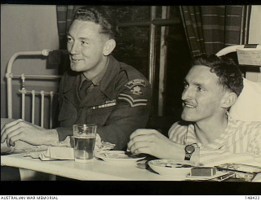
Private Eric Donnelly (right) at Britcom General Hospital, Kure, Japan, following his release. His visitor is a friend from the 3rd Battalion, Royal Australian Regiment (3 RAR). Image courtesy of the Australian War Memorial.