Investigating best practice approaches to the delivery of in-home domestic assistance

23 March 2026
Coversheet of publication - Literature review on best-practice approaches to in-home domestic assistance, including payment models

Literature review on best-practice approaches to in-home domestic assistance, including payment models

Overview

DVA commissioned La Trobe University to investigate literature on best practice in in-home domestic assistance programs in order to provide a contemporary evidence base to inform any future policy and program development aimed at improving DVA domestic assistance service offerings to veterans and families.

First Author
Main Topic
Research Provider
Research Publication Type
Service Period

Australian Gulf War Veterans' Follow Up Health Study

13 March 2026

Australian Gulf War Veterans’ Follow Up Health Study — Summary Report 2015

Australian Gulf War Veterans’ Follow Up Health Study — Technical Report 2015

Overview

The Australian Gulf War Veterans’ Follow Up Health Study 2015 (Follow Up Study) is a follow up to the original Australian Gulf War Veterans’ Health Study 2003 (the 2003 study), also commissioned by DVA, to assess Gulf War veterans’ health and wellbeing 20 years after deployment.

The Follow Up Study is a longitudinal cohort study conducted from 2010 to 2015.  It compares the physical, psychological and social health and military related exposures of Australian Defence Force veterans of the First Gulf War against a military comparison group and the 2003 study.  A mortality and cancer study component of the Follow Up Study involved the entire Gulf War and military comparison groups, comprising a total of 4,793 people.

At follow up Gulf War veterans were found to be resilient. They were likely to have accessed disability and health services, which may suggest that the Gulf War cohort is seeking help when they need it.  At follow up there was a reduction in smoking, with one half of those who reported being a smoker in the 2003 study no longer smoking.

The Follow Up Study found Gulf War veteran participants were more likely than the military comparison group to suffer from a number of conditions, including posttraumatic stress disorder, alcohol disorder, chronic fatigue, irritable bowel syndrome and chronic multisymptom illness.

There were no statistically significant differences in cancer and mortality rates between Gulf War veterans and the military comparison group.

As part of the Australian Gulf War Veterans' Health Study (published in 2003), serum samples were collected from consenting participants, for long-term storage and future potential research. In 2005, a Serum Management Committee (the Committee) was established to provide oversight of the stored samples.

First Author
Research Provider
Research Publication Type
Service Period

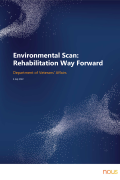
Environmental Scan – Rehabilitation Way Forward (2022)

18 March 2026
Cover of Environmental Scan: Rehabilitation Way Forward

Summary Report

Overview

The focus of this review is the comparison of veteran rehabilitation offerings of the Five Eyes countries to understand where Australia's offerings sit in terms of focus, scope of services and eligibility in relation to comparable schemes.

First Author
Research Provider
Research Publication Type
Service Period

Timor-Leste Family Study (2012)

18 March 2026

Technical Report

Overview

This study investigated the effects on the health and wellbeing of the families of Australian Defence Force members who were deployed to Timor-Leste, and a control group of those who were eligible to deploy to Timor-Leste but did not.

First Author
Research Publication Type
Service Period

Monash University Firefighters’ Health Study (2015)

18 March 2026
Overview

Monash University, "Defence Firefighters' Health Study" April 2015 cover

The Department of Defence, with the support of the Australasian Fire and Emergency Services Council, commissioned Monash University to undertake a statistical study into the health of current and former Australian Defence Force firefighters who served from 1980 to 2013.

The Defence Firefighters' Health Study report is part of the Australian Firefighters' Health Study (available on the Monash University website, under heading "Study Results").

All queries about this research should be directed to the Department of Defence.

First Author
Research Provider
Research Publication Type
Service Period

Cancer incidence study 2003: Australian veterans of the Korean War

18 March 2026
Overview

The Cancer Incidence Study 2003: Australian Veterans of the Korean War was initiated by the Australian Government in May 2001.

The Cancer Incidence Study compared the rates of cancers among the Korean War veteran population with the rates of comparable cancers among the general Australian male population of the same age.

The findings of the Study, conducted by the Australian Institute of Health & Welfare.

First Author
Research Publication Type
Service Period

Independent study into suicide in the ex-service community (2009)

13 March 2026
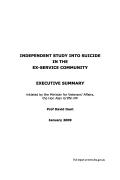
Front cover of the Independent Study into Suicide in the Ex-Service Community Executive Summary

Independent Study into Suicide in the Ex-Service Community Executive Summary

Independent Study into Suicide in the Ex-Service Community

Independent Study into Suicide in the Ex-Service Community

Independent Study into Suicide in the Ex-Service Community - Government response

Independent Study into Suicide in the Ex-Service Community - Government response

Overview

Independent studies by Professor David Dunt - As part of its election commitment, the Australian Government committed to conduct a study to examine the broad issue of suicide in the ex-service community, including a number of specific cases of suicide over the past three years, to help identify the following:

  • ex-service members who are at increased risk of self harm
  • common contributing factors among ex-service members who have committed or attempted suicide
  • the extent of suicide in the ex-service community
  • lifestyle or other factors that may be contributing to suicide in the ex-service community
  • recommended administrative reforms or initiatives to help combat suicide in the ex-service community.

The Government appointed Professor David Dunt to undertake the study. Professor Dunt is a public health specialist and epidemiologist with major interests in health program evaluation and health services research.  He was also appointed to conduct the Review of Mental Health Care in the Australian Defence Force and Transition through Discharge (Defence website).

Prof. Dunt presented his study to the Minister for Veterans’ Affairs in February 2009. The Minister announced the Government’s response (PDF 149 KB) in May 2009.

Terms of reference

The terms of reference for the study were developed in consultation with the National Veterans’ Mental Health and Wellbeing Forum.

See: Suicide study terms of reference (PDF 47 KB)

First Author
Research Publication Type
Service Period

What is the prevalence rate for substance use disorder in contemporary ex-serving veterans?

18 March 2026
Overview

The aim of this review was to determine the prevalence rate of substance use disorder in contemporary ex-serving veterans. Specifically, nicotine, alcohol, drug, and non-specified substance use disorder prevalence rates will be reviewed.

First Author
Research Publication Type
Service Period

What strategies are effective for reducing the stigma associated with mental health disorder?

18 March 2026

Evidence Profile

Summary Report

Technical Report

Overview

This aim of this review was to assess the current standing of public and self-anti-stigma interventions and investigate what has been shown to be an effective intervention to reduce stigma at the public and individual level.

First Author
Research Publication Type
Service Period

What emerging interventions are effective for the treatment of adults with PTSD?

18 March 2026
Overview

The aim of this review was to examine the evidence for the effectiveness of a number of therapies considered to be emerging interventions for the treatment of adults with posttraumatic stress disorder (PTSD). Three broad categories of emerging interventions for the treatment of adults with PTSD were considered. These included psychological interventions (mindfulness and power therapies), physical therapies (acupuncture), and a range of experiential psychotherapies including adventure therapy, art therapy, music therapy, or animal therapy (canine therapy, equine therapy).

First Author
Research Publication Type
Service Period