The Australian Government Department of Veterans' Affairs commissioned the University of New South Wales to design and conduct an exploratory qualitative research study to better understand culturally and linguistically diverse (CALD) veterans' service access needs and experiences, and the enablers and barriers to engaging with the veteran support system. The research offers preliminary insights into how the veteran support system may better meet the needs of CALD veterans and families of veterans.
Produced by the Australian Institute of Health and Wellbeing (AIHW), this report quantifies the level of suicide among serving and ex-serving Australian Defence Force (ADF) personnel and identifies factors that may be associated with suicide risk. Analysis in the summary report examined each service-related characteristic associated with risk of suicide individually.
The aim of this research was to compare the prevalence of affective, anxiety and substance use disorders, and the use of mental health services, between respondents identifying with the Australian Defence Force (ADF) or the Department of Veterans’ Affairs (DVA) and the general population. The reserach used 2007 National Survey of Mental Health and Wellbeing (NSMHW 2007) data (a nationally representative household survey of 8,841 respondents aged between 16 and 85).
In Australia, the Department of Veterans’ Affairs (DVA) covers the costs of medical grade footwear for veterans who have severe foot deformity. However, there is a high demand for footwear by veterans with foot pain who do not meet this eligibility criterion.
This project, by La Trobe University, describes a randomised controlled trial to evaluate the effectiveness of low cost, off-the-shelf footwear in reducing foot pain in DVA recipients who are not eligible for medical grade footwear.
This study was conducted by the National Ageing Research Institute (NARI) and the Institute for Breathing and Sleep (IBAS). The aim of the study was to undertake a preliminary investigation of whether specific sleep difficulties were associated with history of falls and risk of falling in older people.
It examined that falls and associated falls injuries can result in numerous other problems for older people, such as physical and functional decline, residential care admission, fear of falling and depression. The paper assessed whether the problem of sleep difficulties in older people is a risk factor for falls.
This literature review looked at how military service can shape the risk of social isolation among younger veterans, the factors that increase or reduce that risk, and the impacts on those who care for them.
The Australian Government Department of Veterans' Affairs commissioned ORIMA Research to conduct a qualitative study on the experiences of self-employed veterans and the impact of self-employment on their wellbeing. The research aimed to inform policy and program improvements to support veteran wellbeing during their transition to civilian employment.
The Department of Veterans’ Affairs (DVA) commissioned the University of New South Wales (UNSW) to undertake a Rapid Evidence Assessment (REA) to examine the current certainty of evidence regarding repetitive low-level blast (rLLB) exposure in humans.
The review analyses and interprets human, animal and grey literature to understand the relationship between repetitive low-level blast exposure and potential neurocognitive changes or blast-caused brain injuries during military training and operations.
This review will establish a baseline of current research, with a series of updates on any new literature conducted at regular intervals. Any relevant findings on current research gaps and limitations will guide best-practice developments to the way blast-caused brain injuries and cognitive impairments are assessed and treated in veterans.
The Department of Veterans' Affairs commissioned Abt Associates to undertake an evaluation of the Coordinated Veterans’ Care (CVC) Program. The evaluation was commissioned as part of a 2020-21 Budget measure which expanded access to the CVC Program for White Card holders with an accepted mental health condition. Findings from the final report will inform future improvements to veteran health care arrangements.
This report will be provided to the Department of Prime Minister and Cabinet for further consideration in the context of the Government’s response to Recommendation 72 of the Royal Consideration into Defence and Veteran Suicide Final Report.
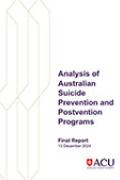
The Department of Veterans' Affairs (DVA) commissioned Australian Catholic University (ACU) National Centre for Veterans and Families to determine the number and accessibility of suicide prevention and postvention programs for the Australian veteran community. The project aims to enhance DVA's understanding of the number and location of Australian suicide prevention and postvention programs and the future needs of the veteran community regarding suicide prevention and postvention programs.