Rapid Evidence Assessment

Overview

This Rapid Evidence Assessment investigates the research literature analysing the risk factors for ex-serving personnel entering corrective services systems in Australia and/or other relevant jurisdictions. The report examines and synthesises recent research evidence regarding risk factors for entry into corrective services systems by ex-serving personnel across the United States, the United Kingdom and Australia.

1 April 2026
Cover of the Understanding Evidence report

Understanding Evidence

Overview

The Understanding Evidence: A Framework for Guiding the Use of Evidence in Decision Making for Mental Health Interventions including Adjunct Therapies (the Understanding Evidence Framework), is an easy to use guide to assess the supporting scientific evidence when making a decision about an intervention.

1 April 2026
Overview

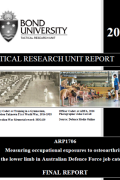
The Department of Veterans’ Affairs (DVA) commissioned Bond University, Tactical Research Unit to quantify exposures that occur during the initial training of full-time Australian Defence Force (ADF) personnel and compare those findings with the exposure threshold levels set out in the Statements of Principles for osteoarthritis in the lower limb established by the Repatriation Medical Authority.

The study’s findings have supported the work undertaken by DVA to improve access to services, streamline the compensation claims process, and fast track access to treatment by lessening the need for some veterans to explain how their service has caused OLL when submitting claims to DVA.

1 April 2026
The impact of war experiences on dementia in veterans report cover page

Final report March 2012

Overview

This project was funded by the Department of Veterans’ Affairs to investigate the relationship between post-traumatic stress disorder (PTSD) and dementia in veterans. Recently, links have been made in the medical literature between PTSD and the incidence of dementia, with epidemiological evidence that the odds of developing dementia are 1.7 to 2 times greater in veterans with a diagnosis of PTSD. These findings from analyses of USA Veterans’ Affairs data led us to pose research questions about dementia and PTSD in Australian veterans. No Australian large scale data bases with variables on PTSD diagnoses and dementia diagnoses were available to replicate the USA analyses for older Australian veterans. However, a community survey of dementia, the EACHD evaluation survey, included veteran status as a survey item and provided the basis for an opportunity to address questions related to the issue. 

We aimed to answer the research questions:

  1. What is the profile of behavioural and psychological symptoms of dementia (BPSD) in Australian veterans?
  2. Is the profile of BPSD different in veterans and non-veterans?
  3. Is the profile of BPSD different in veterans with PTSD and veterans without PTSD?

DVA's response to the report

The Department of Veterans’ Affairs (DVA) contracted The Centre for Health Policy Programs and Economics, The University of Melbourne, to investigate the relationship between Posttraumatic Stress Disorder (PTSD) and dementia in a sample of Australian veterans.  The research was funded under DVA’s Applied Research Program.

DVA is responsible for providing and purchasing health and aged care services worth over $5 billion a year for some 240,000 clients across Australia in the veteran community.  Of this health treatment population:

  • 44% are aged 85 years and over;
  • clients who are aged 85 years and over also make up 1 in 4 (or 26 per cent) of all Australians in this age group; and
  • clients who are in residential aged care make up over 15% of all residents.

Given the age structure of the health treatment population and the increasing likelihood of living with dementia in the very old age group, dementia is and will continue to be a significant priority for the veteran community and DVA.

DVA has considered the research report and notes that this is the first Australian study to explore the relationship between symptoms of dementia and PTSD.  The research indicated that dementia symptoms were different in veterans and non-veterans.  Additionally, veterans with PTSD had more significant behavioural and psychological symptoms of dementia than veterans without PTSD.  

A limitation of the study was the small sample and further studies are needed to replicate this finding and understand why specific behavioural and psychological symptoms of dementia are more prevalent among veterans than non-veterans.

In April, the Government made a significant announcement about aged care, proposing reforms to the way in which aged care is financed to ensure that older Australians will continue to be able to access the care that they need, when they need it.  This includes greater availability of care places, especially community care, and more funding for dementia care.

The package includes one veteran specific initiative, More Support for Veterans in Commonwealth Home Care Packages and Residential Aged Care.  The initiative aims to improve access to appropriate care for veterans with an accepted mental health condition who receive a home care package or are in residential care.  It will start in July 2013 and be funded as $96.6 million over five years net spending.

The mental health conditions to be covered by these arrangements include post traumatic stress disorder, depressive disorder, anxiety disorder, alcohol dependence or abuse and adjustment disorder.  The full list of conditions will be determined before the initiative starts.

Dementia will continue to the considered by the Department in its policy development for both mental health and aged care.

30 March 2026
Overview

Monash University, "Defence Firefighters' Health Study" April 2015 cover

The Department of Defence, with the support of the Australasian Fire and Emergency Services Council, commissioned Monash University to undertake a statistical study into the health of current and former Australian Defence Force firefighters who served from 1980 to 2013.

The Defence Firefighters' Health Study report is part of the Australian Firefighters' Health Study (available on the Monash University website, under heading "Study Results").

All queries about this research should be directed to the Department of Defence.

1 April 2026
Overview

The Cancer Incidence Study 2003: Australian Veterans of the Korean War was initiated by the Australian Government in May 2001.

The Cancer Incidence Study compared the rates of cancers among the Korean War veteran population with the rates of comparable cancers among the general Australian male population of the same age.

The findings of the Study, conducted by the Australian Institute of Health & Welfare.

1 April 2026
Monash University Health Study 2005 - Australian Veterans of the Korean War cover.

Health Study 2005: Australian Veterans of the Korean War

Overview

The Health Study 2005: Australian Veterans of the Korean War is the third and final study in a series of studies of the health of Australian Korean War veterans. The reports for first two studies, the Cancer Incidence Study and the Mortality Study, were released in 2003. The three studies constitute a major study program of health in this Australian veteran population and represent one of the most comprehensive investigations of health ever conducted in an entire veteran group.

Health Study 2005: Australian Veterans of the Korean War was prompted by recommendations from the first two studies concerning the need for a general health survey of Australian Korean War veterans. The study compared surviving male Korean War veterans with a group of men of similar age who were resident in Australia at the time of the Korean War but who did not serve in Korea.

The study was commissioned by the Repatriation Commission, managed by the Department of Veterans' Affairs and conducted by Monash University.

30 March 2026
Front cover of the Independent Study into Suicide in the Ex-Service Community Executive Summary

Independent Study into Suicide in the Ex-Service Community Executive Summary

Independent Study into Suicide in the Ex-Service Community

Independent Study into Suicide in the Ex-Service Community

Independent Study into Suicide in the Ex-Service Community - Government response

Independent Study into Suicide in the Ex-Service Community - Government response

Overview

Independent studies by Professor David Dunt - As part of its election commitment, the Australian Government committed to conduct a study to examine the broad issue of suicide in the ex-service community, including a number of specific cases of suicide over the past three years, to help identify the following:

  • ex-service members who are at increased risk of self harm
  • common contributing factors among ex-service members who have committed or attempted suicide
  • the extent of suicide in the ex-service community
  • lifestyle or other factors that may be contributing to suicide in the ex-service community
  • recommended administrative reforms or initiatives to help combat suicide in the ex-service community.

The Government appointed Professor David Dunt to undertake the study. Professor Dunt is a public health specialist and epidemiologist with major interests in health program evaluation and health services research.  He was also appointed to conduct the Review of Mental Health Care in the Australian Defence Force and Transition through Discharge (Defence website).

Prof. Dunt presented his study to the Minister for Veterans’ Affairs in February 2009. The Minister announced the Government’s response (PDF 149 KB) in May 2009.

Terms of reference

The terms of reference for the study were developed in consultation with the National Veterans’ Mental Health and Wellbeing Forum.

See: Suicide study terms of reference (PDF 47 KB)

30 March 2026
Cover image of final report showing the ANU Enterprise logo.

Appendices to the report

Cover image of final report showing the ANU Enterprise logo.

The Health and Wellbeing of Female Vietnam and Contemporary Veterans Report

Cover image of ADF Service Women Steering Committee report showing Australian Government logo

The ADF Service Women Steering Committee Report

Cover image of ADF Service Women Steering Committee report showing Australian Government logo

The joint Defence/DVA response

Overview

The Department of Veterans’ Affairs (DVA) commissioned Dr Samantha Crompvoets to lead a study in 2009 into the health and wellbeing of female Vietnam and contemporary veterans. The study was completed in 2012. The report’s findings were based on in-depth interviews with 60 female veterans and 30 workers in the female veteran health and wellbeing field, as well as reviews of previous research.

The ADF Service Women Steering Committee report and joint Defence/DVA response 

The Departments of Veterans’ Affairs and Defence jointly established the ADF Service Women Steering Committee (the Committee) to provide recommendations for improving Defence and DVA services for current and former ADF members. The Committee’s membership included current and former soldiers, sailors and air women (regular/permanent and reserve).

The Committee considered Dr Crompvoets’ report and discussed practical ways to improve current and former ADF service women’s access to services.

The Committee concluded that there are no major gaps evident in Defence or DVA services for current and former ADF service women, but identified that there was a lack of awareness by women of available support and services.

The Committee also found that significant changes have occurred with the services provided by Defence and DVA during and since Dr Crompvoets’ study that have enhanced care and support for contemporary veterans, including female veterans, and their families.

The Committee made 24 recommendations. DVA and Defence have accepted the majority of the Committee’s recommendations and will continue to work together to improve responsiveness to the needs of women who serve or have served our nation.

The ADF Service Women Steering Committee

With approximately 14 per cent of the Australian Defence Force (ADF) being female, female veterans are making up an increasing proportion of DVA clients. In 2012, an average of 345 females served on overseas operations at any given time, with their roles including logistics, health, communications, transport, signals, engineering and intelligence. The start of 2013 saw the ADF open all employment categories to servicewomen and a new Army recruitment campaign to increase the number of women serving over the next 12 months.

More than 11 000 veterans with one or more accepted conditions under any Act administered by DVA are female. In the last few years the Department has significantly improved services for contemporary veterans, including female veterans. DVA and Defence have also recognised that female veterans have unique requirements and so have established an ADF Service Women Steering Committee to inform both departments of the specific needs of women.

The committee is co-chaired by Gayle Anderson, Assistant Secretary Service Development and Defence Relations Branch (DVA) and MAJGEN Gerard Fogarty AO, Head of People Capability, Defence. Membership includes female current and former serving members (both regular and reserve) who have deployed on operations to Somalia, Timor Leste, Iraq and Afghanistan.

The committee is considering a broad range of information, including research by Dr Samantha Crompvoets of the Australian National University which was funded through DVA’s Applied Research Program. The study, completed in 2012, was commissioned to look at the needs of the growing number of female veterans. The report from this study into the health and wellbeing of female Vietnam and contemporary veterans is available on the DVA website.

The ADF Service Women Steering Committee has met three times between May 2013 and 30 June 2013 and will continue to meet regularly until August 2013, after which the Committee will report to the Repatriation and Military Rehabilitation and Compensation Commissions with recommendations to further guide service design.
30 March 2026
Service Needs of Contemporary DVA Clients cover

Service Needs of Contemporary DVA Clients

Overview

The context in which the Department of Veterans’ Affairs (DVA) operates is changing. Younger clients, changing demographics, differing needs and expectations, and technological advances mean new ways of doing business. As part of its overall strategic planning, DVA is presently developing a number of improved models of service delivery focused on meeting the needs of current client target groups.

30 March 2026