DEFENCE NEWS
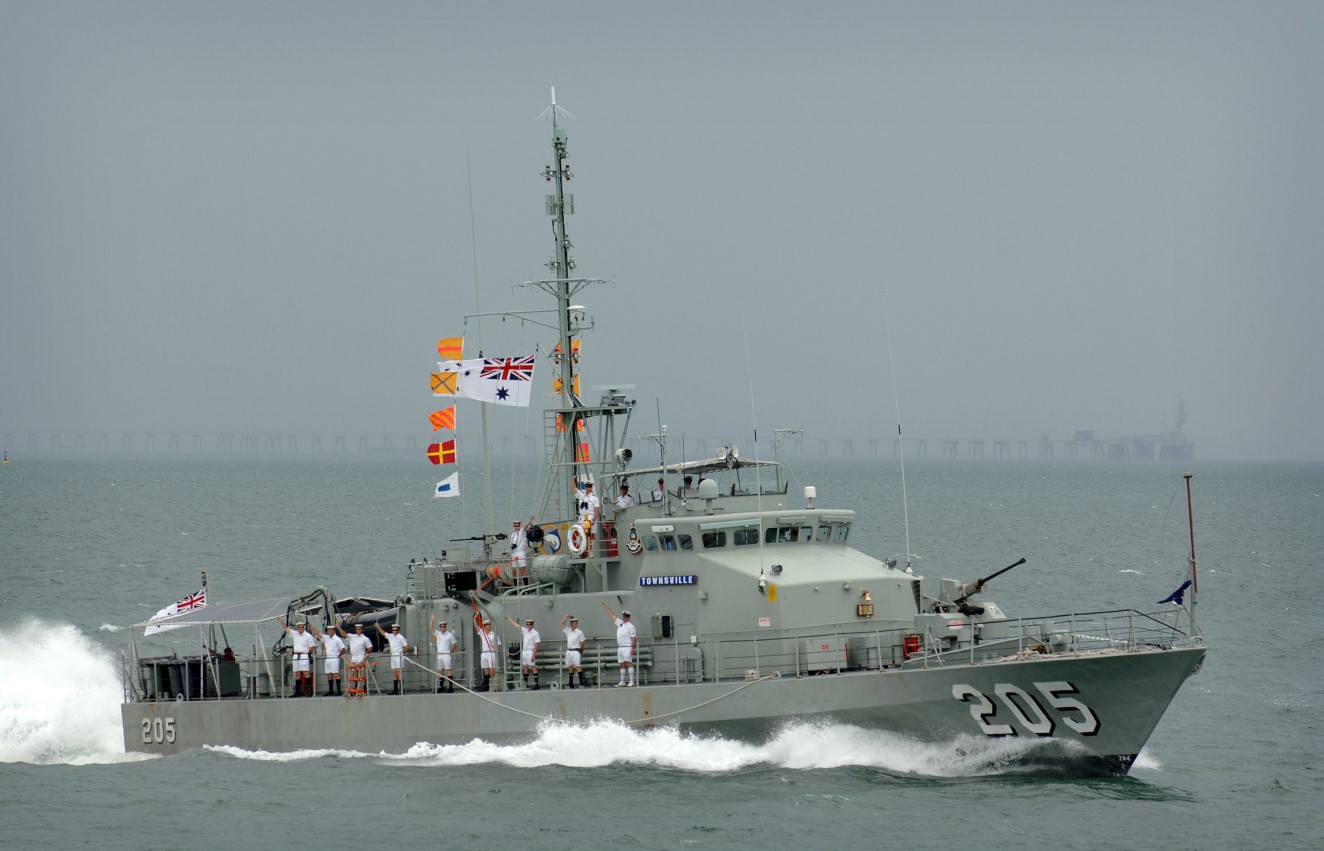
Honouring a Fremantle-class legend at Townsville
On a bright North Queensland morning, the former Royal Australian Navy patrol boat HMAS Townsville II made its final journey up Ross Creek, finding a new home at the Townsville Maritime Museum. For locals and Navy veterans, the occasion marked the celebrated return of one of only 2 surviving Fremantle-class patrol boats. Their service from 1981 to 2007 left an enduring legacy.
Commissioned in 1981, Townsville was among 15 Fremantle-class vessels built to patrol Australia’s vast coastline. For 26 years, its hull patrolled Australia’s waters, often working with other government agencies, mainly in Australia’s northern waters, but also deployed to countries in Southeast Asia and the Pacific.
Throughout her career, Townsville’s dedicated crews performed a wide range of missions: border protection, illegal fishing patrols, customs surveillance, and search and rescue. The vessel supported the Pacific region and participated in major operations, notably Operation Morrisdance in the South-West Pacific in 1987.
Townsville gained fame beyond her duties by starring in the popular Australian TV series Patrol Boat. The show highlighted naval life and built a lasting connection between the ship, its crew and the wider community.
Read the full story on Defence News.
Resilient ADF children celebrated
More than 120 children of serving ADF members gathered to recognise the significant contribution that Defence families make to Defence capability at a ceremony at Sydney’s Anzac Memorial in Hyde Park. Each child received a Child of the ADF Medallion, a symbol of recognition for the strength, resilience and sacrifices made by Defence families.
Defence spouse Caitlyn explained how her 3 young boys were already beaming with pride to show their “hard-earned” medallions to their father, a chief petty officer on board HMAS Brisbane: ‘The boys have had to be quite resilient over the past year, with their father being away on 2 deployments. I am so proud of our boys, they have done so well managing it. They are all so proud of their dad.’
Eldest son William said his father’s example of service is one of the most important influences in his life, one he and his brothers, Lucas and George, aspire to live by: ‘We all try to be good for mum and we help out as much as we can. We need someone big and strong in the family to look after us. As the biggest, I try to help out with the dishes and I mow the lawn when needed. We miss dad very much.
Read the full story on Defence News.
Remote weapons technology tested
During Exercise Talisman Sabre, 1st Armoured Regiment tested the Modular Robotic Vehicle (MRV) with remote weapon stations, and first-person view drones (FPVD), for the first time in a combat field environment.
The MRV currently uses an M113 Armoured Personnel Carrier as a ‘test bed’, with 50-calibre machine guns or M23D minigun remote weapon stations attached. This technology allows soldiers to control the vehicle and weapon station using a remote control from up to 1000 metres away. Similarly, FPVD are operated using a headset and hand controller.
Officer Commanding Major Tom Fisher said these drones could travel up to 20 kilometres from the operator, reaching speeds of up to 70km/h with the ability to provide a strike function when weaponised with a payload. ‘It allows the war-fighter to strike targets at range without placing themselves at risk,’ he said. ‘The capability is quite early on, but looking to the future, this kind of capability can bring a heavy amount of firepower to bear without putting soldiers in harm’s way, which is really promising.’
Read the full story on Defence News.
Review recommends Cyber Reserve
The Strategic Review of the Australian Defence Force Reserves identified 17 recommendations to modernise the ADF Reserve, supporting an integrated, focused force prepared to meet evolving strategic challenges. The review recommendations aim to strengthen Reserve contributions across the workforce, build capability and boost the specialist domains, including space and cyber.
A key recommendation is the Cyber Reserve Concept, developed to support the Defence Strategic Review’s call for enhanced resilience, workforce agility and sovereign capability in the cyber domain. Cyber reserves will contribute specialised skills to safeguarding Australia’s critical networks, be part of a pioneering force that strengthens national resilience, and make an operational impact on Defence cyber missions.
Colonel John Molnar, Director Cyber Reserve Concept Support, said expressions of interest and a refinement of entry processes would be issued in the coming months to support activation of the cyber reserve capability by early 2026. ‘The Cyber Reserve Concept is developing a powerful new way for Australians to serve by bringing their skills to the frontline of national cyber defence,’ he said.
The Concept incorporates organisational design, policy frameworks and pathways for on-boarding mid-career specialists, including reservist personnel. A flexible service model will underpin the Cyber Reserve workforce.
Read the full story on Defence News.