Other in-home aged care programs
On this page
Other in-home aged care programs available and how you can use these services alongside support from DVA.
The veteran’s guide to living independently booklet has been developed to help you understand the services and supports available. You can view this online or order a hardcopy to be delivered to your home, from the aged care resources page of the website.
What are the other in-home aged care programs?
Outside of the services which DVA is able to offer older clients, there are other government-funded aged care programs available to help older people remain independent. Most people want to continue living in their home for as long as they can and these programs assist by offering support ranging from basic through to more complex services.
The new Aged Care Act commenced on 1 November 2025, and along with this there were changes to the in-home aged care programs accessed through My Aged Care. Read on below for the current programs available and how to access them.
Commonwealth Home Support Program
The Commonwealth Home Support Program (CHSP) provides older people with access to basic support services to help maintain their independence. This program will transition to the new Support at Home program no earlier than 1 July 2027.
The CHSP provides entry-level support, such as personal care, social support, respite and home maintenance services to help older people live independently and safely at home.
People accessing CHSP services can be asked to contribute towards the cost of care by paying a contribution or fee to providers. Fees are not formally means tested and are decided by the CHSP provider.
To find out more about CHSP and how to access services see the Accessing in-home supports with My Aged Care section below, visit the My Aged Care website or call My Aged Care on 1800 200 422.
Support at Home program
The Support at Home program replaced the Home Care Packages Program and the Short-Term Restorative Care Programme on 1 November 2025. It provides access to services, products, equipment and home modifications to help you remain healthy, active and socially connected.
The Support at Home program provides ongoing services in 3 categories:
- clinical supports such as nursing care, occupational therapy, physiotherapy and care management.
- independence services such as personal care, community engagement, and transport.
- everyday living services such as domestic assistance, basic home maintenance, and meals.
The program also includes 3 short-term pathways:
- Assistive Technology and Home Modifications scheme that provides supports to live at home with increased independence, safety, accessibility and wellbeing.
- Restorative Care Pathway to improve function and regain abilities or delay the need to access higher levels of aged care.
- End-of-Life Pathway, which gives people who have less than 3 months to live access to more funding for in-home aged care services, alongside local palliative care programs. This aims to help older people remain at home as they near their end of life.
For more information, see the Support at Home booklet for older people, visit the My Aged Care website or call 1800 200 422.
Back to topWho is eligible?
An aged care assessment will determine your eligibility for government-funded aged care services to help with aged care related needs.
To qualify for an assessment, you must meet some needs and age requirements, which check:
- how much assistance you need with some everyday tasks
- that you are 65 years or older
- if you have care needs and are either:
- an Aboriginal or Torres Strait Islander person aged 50 to 64 years
- homeless or at risk of homelessness and aged at least 50;
Accessing in-home supports with My Aged Care
If you have not previously accessed government-funded aged care services outside of DVA you will first need to arrange an aged care assessment. You can do this:
- online on the My Aged Care website by completing the Apply for an assessment form
- over the phone by calling My Aged Care on 1800 200 422
(Weekdays – 8am to 8pm, Saturdays – 10am to 2pm, Closed on Sundays and public holidays) - in-person by booking an appointment with an Aged Care Specialist Officer in selected locations. To arrange an appointment, call 1800 227 475 (Monday to Friday – 8am to 5pm) or visit any Services Australia service centre for general My Aged Care support.
We encourage you to register and arrange an assessment as early as you can as it can take time to get assessed and establish services.
What to say when you call – “I need an aged care needs assessment as I need help with [insert the tasks] at home. Can you please organise this for me?”
The process to arrange assessment and receive your outcome is:
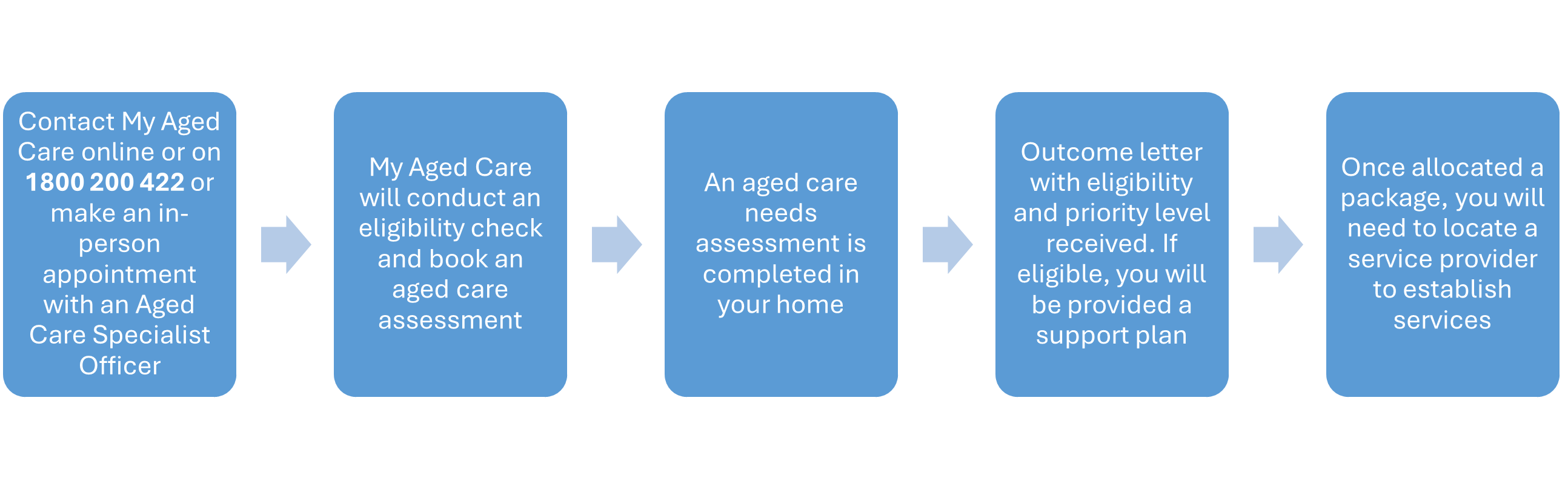
If you are assessed as eligible for CHSP, you will receive a Notice of Decision letter outlining the service types you have been approved for and their referral codes. You will use the codes to access services through a CHSP provider.
Visit the My Aged Care website for more information on the Commonwealth Home Support Program, Support at Home program, applying for an aged care needs assessment, finding a provider and to use the find a provider tool.
Back to topUsing DVA and other aged care services
As a DVA client 65 years* or over you can speak with both DVA and My Aged Care for assistance with accessing aged care services. DVA supports access to a range of aged care services. However, when your care needs become more complex, veterans may also use mainstream services organised through other government departments, provided there is no duplication of services.
This means you can receive DVA services alongside other support, as long as the services do not overlap. For example, if you receive DVA funded cleaning services that fully meet your assessed need, you cannot access additional cleaning services through other aged care programs. However, if you are receiving DVA services that only partly meet your needs, you can apply for an assessment through My Aged Care to determine if additional in-home aged care services can be provided.
It is important you consider all government-funded aged care services. This will allow you to select individual services or a combination of services that best suit your overall support needs. Your eligibility for services is determined based on your age and care needs.
What to say when you call – “I need an aged care needs assessment as I need help with [insert the tasks] at home. Can you please organise this for me?”
*The eligibility is 50 years or over for Aboriginal and Torres Strait Islander people and people who are homeless or at risk of being homeless. For more information visit Am I eligible? | My Aged Care or call 1800 200 422 to discuss your situation.
The below table provides a guide to the types of help you can get through DVA mapped against services available through the Support at Home program or the CHSP (except care management and restorative care management). Please note limits and co-payments apply to some services. Furthermore, DVA programs are based on your needs as assessed by a suitable health provider or assessment organisation, and your eligibility under your Veteran Card.
Please note: The Support at Home program replaced the Home Care Packages Program and Short-Term Restorative Care Programme from 1 November 2025.
| Support at Home – service list categories | Comparable DVA programs and services | |
|---|---|---|
|
Clinical supports |
Allied health and other therapeutic services | Allied health services |
| Assistive technology and home modifications, prescriptions and wrap-around services | Rehabilitation Appliance Program (RAP) | |
| Care management |
Care plans (via GP) |
|
| Nursing care | Community Nursing Program | |
| Nutrition | Nutritional products available through Repatriation Pharmaceutical Benefits Scheme (RPBS) | |
| Restorative care management | GP, Convalescent Care, Allied health services | |
| Independence services | Assistive technology products, equipment and home modifications | Rehabilitation Appliance Program (RAP) |
|
Personal care
|
Veterans’ Home Care (VHC) Rehabilitation Appliance Program (RAP) Repatriation Pharmaceutical Benefits Scheme (RPBS) medication webster packs |
|
| Respite |
Respite (care at home, residential) |
|
| Social Support and Community Engagement | Coordinated Veterans’ Care Program (CVC) | |
|
Therapeutic services for independent living (Acupuncturist, Chiropractor, Diversional therapist, Remedial masseuse, Art therapist, Osteopath) |
Allied health services (physiotherapist, osteopath and chiropractor services only) | |
| Transport | Travel for treatment only | |
| Everyday living services | Domestic assistance |
Veterans’ Home Care (VHC) |
| Home maintenance and repairs |
Veterans’ Home Care (VHC) |
|
| Meals |
Veterans’ Home Care (VHC) (shopping and meal preparation only) Household Services compensation (shopping and/or meal preparation) |
*Legislated limits may apply.
Back to topHow your in-home aged care costs are assessed
Some government aged care services provided outside of DVA may require a contribution. How much you pay will be determined by assessing your income and assets through a means assessment. Depending on your circumstances, this assessment may be administered by DVA or Services Australia. A means assessment for aged care services is a review of your income and assets. It determines how much the government will subsidise your contribution (if you are eligible for government assistance) and the amount you can be asked to contribute towards your aged care costs.
More information can be found on how your costs will be assessed on the assessing your in-home aged care costs page.
Back to topCommunity Connections
Aged Care Volunteer Visitors Scheme
The Aged Care Volunteer Visitors Scheme (ACVVS) matches a volunteer visitor to an older person who is socially isolated or lonely. This helps provides friendship and companionship. Older people receiving Support at Home services, or on the Support at Home Priority System, can request a volunteer visitor. Family, friends, and aged care or health professionals can also refer an older person to the program with their consent.
Read more on the Aged Care Volunteer Visitors Scheme (ACVVS) page.
Volunteering in Aged Care
Volunteering in aged care contributes to and can lead to positive outcomes for the older person and the veteran. These benefits can include increased mental health and wellbeing, social connectedness and reduced isolation.
Volunteering can occur:
- in a residential aged care home
- in an older person’s own home (if they are receiving in-home or community care)
- in public (for example accompanying an older person to a coffee shop, park, etc)
- between locations (for example delivery of meals, transport to appointments and community centres).
To find out more about opportunities to volunteer in aged care go to the Volunteering in aged care page.
Back to topHelp accessing aged care services
It’s no secret aged care can be confusing and it’s often difficult know where to start. You don’t have to do it alone. There are many services available through the government as well as independent services that can support you on your aged care journey.
The help accessing aged care services page provides information on available support. There are also further support services to help you understand and navigate aged care. You can explore these options by visiting the getting support in aged care page on the My Aged Care website.
Back to topOther pages we think may interest you
- Aged care resources
- Help with personal care
- Help with cleaning and housekeeping
- Nursing help at home
- Help with home and garden upkeep
- Getting aids, equipment and home modifications
- Assessing your in-home aged care costs
- Retirement villages
- How to find your accepted conditions on MyService
- Carer support