Respite care
Respite options available through DVA.
The veteran’s guide to living independently booklet has been developed to help you understand the services and supports available. You can view this online or order a hardcopy to be delivered to your home, from the aged care resources page of the website.
Nominating a representative
You may choose to authorise someone to be your nominated representative when dealing with us. A nominated representative can be a partner, adult relative, trustee, agent, legal representative or organisation. You can set up a nominated representative using MyService or by completing this form - Appointing a third party to represent a DVA client. For more information visit the nominated representative page.
Please note that this form only authorises representation with DVA. Other government departments or services may require you to create other arrangements. Information on representation arrangements for other departments can be found on the help accessing aged care services page.
Back to topWhat is respite care?
Respite care provides temporary relief for carers, allowing them to take a break from their caring duties, while the person they care for receives care from someone else.
We provide three types of respite care:
- in-home respite - allows a carer to have a break while another carer comes into the home to take over the caring role
- residential respite - provides short-term care, usually in an Australian Government-funded aged care home
- Emergency Short-Term Home Relief (ESTHR) - provides short-term care in the home when the carer is unexpectedly unavailable to provide care
Who is a carer?
A carer can be a friend, partner or family member who provides ongoing care to someone who is frail or has a severe disability or illness. The carer does not need to live with the person they care for.
Back to topWho is eligible?
You may be eligible for respite care if you have a carer or you care for someone and you have either one of the following:
The types of respite you can access will depend on your situation.
Back to topIn-home respite
Caring for someone can be mentally and physically demanding. In-home respite gives a break to a carer by temporarily relieving them of their caring responsibility. In-home respite can be for regular visits or one-off situations. It gives the carer the chance to attend to everyday activities and supports carers who have other commitments, such as attending appointments, recreational activities, attending to self-care activities, taking short breaks, recovering from illness or attending to work/employment or school/education commitments.
You may be eligible for in-home respite if either:
- You are being cared for, and your carer needs a break from their caring duties, or
- You are caring for someone, and you need a break from the caring role.
Accessing In-home respite
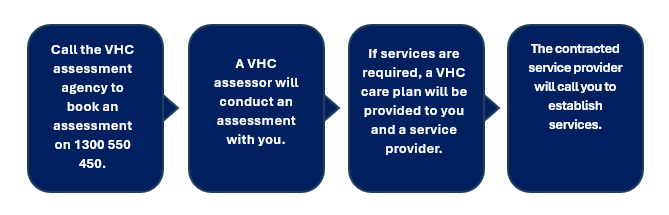
Residential respite
Residential respite provides short term care for a client in an Australian Government funded aged care or other appropriate setting to give the carer a break from their caring duties or while their main carer is absent or unable to provide their normal level of care.
You may be eligible for residential respite if:
- you are being cared for and your carer needs a break from their caring duties; or
- you are a self-carer but are in need of respite care; and
- you intend to return to the community
Accessing residential respite
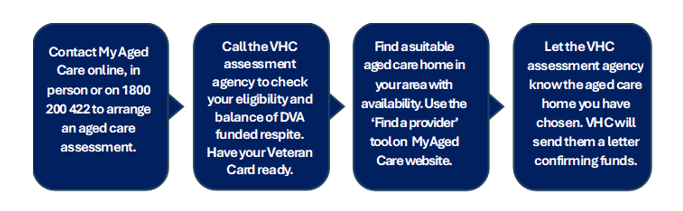
To access residential respite you will first need to arrange an aged care assessment. You can do this:
- online on the My Aged Care website by completing the Apply for an assessment form
- over the phone by calling My Aged Care on 1800 200 422
(Weekdays – 8am to 8pm, Saturdays – 10am to 2pm, Closed on Sundays and public holidays) - in-person by booking an appointment with an Aged Care Specialist Officer in selected locations. To arrange an appointment, call 1800 227 475 (Monday to Friday – 8am to 5pm) or visit any Services Australia service centre for general My Aged Care support.
If eligible, you will need to find an available respite bed at a government-funded aged care home. You can find an aged care home in your area by going to My Aged Care - Find a provider. Contact the facilities you are interested in to find out if they have an available bed.
Once you have booked your respite bed, call the VHC assessment agency directly on 1300 550 450 so they can arrange for us to pay for your care.
If a government-funded aged care aged care home is not suitable or available, you may be able to get residential respite in another type of accommodation. Call the VHC assessment agency directly on 1300 550 450 to discuss your options and get approval.
Back to topEmergency short-term home relief
Emergency short-term home relief (ESTHR) provides short term care in the home when the carer is suddenly unable to provide care.
You may be eligible for ESTHR if both:
- your carer is suddenly unable to continue their caring duties, and
- you would otherwise be left without care or admitted to hospital
ESTHR is only available until you can access other suitable care.
Accessing ESTHR
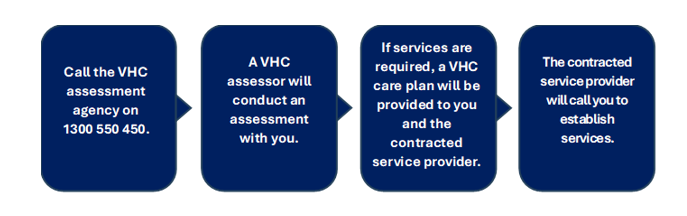
Call the VHC assessment agency directly on 1300 550 450 to arrange an assessment.
The VHC assessment agency will discuss your needs and organise a care plan. They will send your care plan to a VHC Service Provider, who will then send the plan to you and contact you to arrange a suitable time to provide the service or services.
To arrange emergency respite outside business hours you can contact Carer Gateway on 1800 422 737.
Back to topHow much you can get
Each financial year we will pay for up to either:
- 28 days of residential respite care; or
- 196 hours of in-home respite care; or
- a combination of both
To work out a combined total, we count 7 hours of in-home respite care as equal to 1 day of residential respite. If you need more than 28 days of residential respite, you can contact My Aged Care to ask about additional days.
The below table summarises the legislated limits per financial year for different types of respite:
| Respite care | Financial year annual limit |
|---|---|
| In-home respite | 196 hours |
| Residential respite | 28 days |
| In-home and residential respite combination | 196 hours, with 7 hours of in-home care equal to 1 day of residential care |
| ESTHR | 216 hours, 72 hours each episode or until alternative care is arranged |
Cost
There is no cost for respite care provided through the VHC program if it is within the limits listed above.
DVA clients can access additional days of residential respite (up to 63 days) by contacting My Aged Care, however you will need to pay the basic daily care fee. For more information, please:
- visit the My Aged Care website or
- call My Aged Care on 1800 200 422.
If you are a former Australian prisoner of war or a Victoria Cross recipient, we will pay the basic daily fee for up to 63 days.
We do not cover the cost of higher everyday living fees or refundable booking fees.
Some government-funded aged care homes may request a booking fee to secure a period of respite care. It will not be more than the cost of one week's respite care, or 25 per cent of the fee for the proposed period of respite care, whichever is less. The government-funded aged care home is responsible for refunding any unused booking fee to you after your respite stay.
Back to topWhat to tell us
If you receive a Service Pension or Age Pension from us you need to tell us within 14 days if any changes occur that may affect your pension.
This includes if you or your partner enters residential respite for 14 days or longer.
If you get a Service Pension or an Age Pension from us as a member of a couple, and you enter residential respite for at least 14 days in a row, you and your partner may be entitled to the higher single rate of pension as an illness separated couple. Contact us and let us know within 3 months of entering respite so we can adjust your pension rate.
Back to topOther options
The Australian Government funds a range of short-term respite including in-home, emergency and residential respite but also:
- Centre-based respite – available during the day as an opportunity for interaction with other people at a day centre, club, or residential setting. Day respite often runs from 10am to 3pm and may include transport to and from the centre.
- Cottage respite is available overnight or over a weekend. It takes place in aged care accommodation or community setting and is normally for two or three days at a time.
You can find more details by visiting the Respite care webpage on the My Aged Care website or by calling them on 1800 200 422.
Back to top